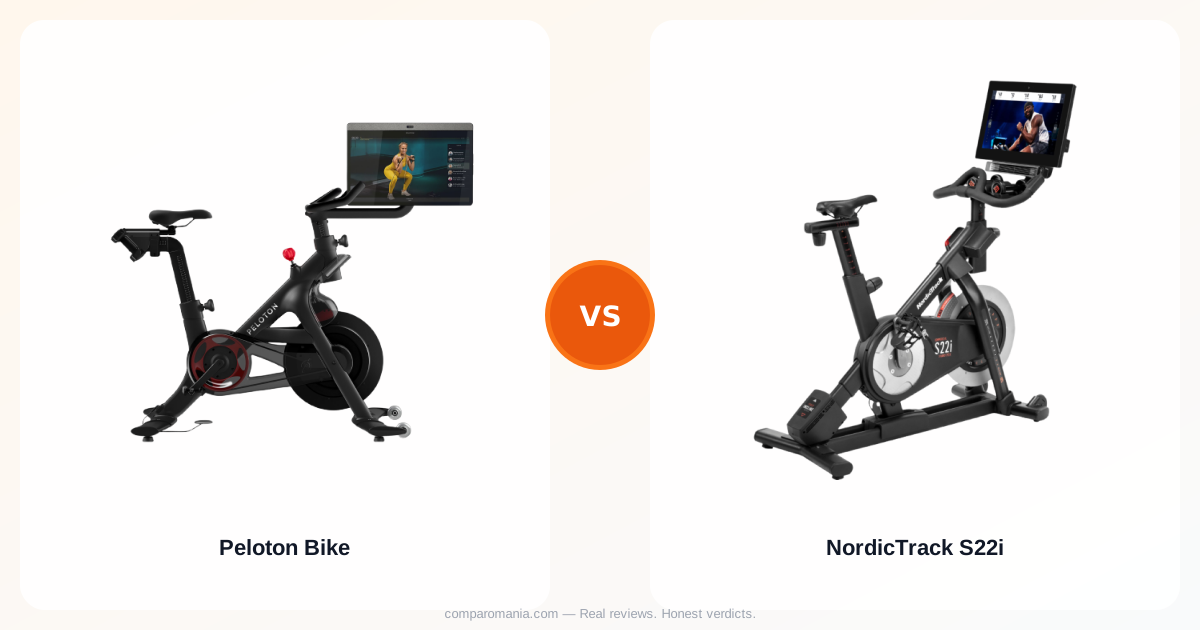
You've got a corner of the spare room cleared. You've watched the brand videos. You've done enough comparison reading to know the basics, both bikes have big touchscreens, both need a subscription, both cost real money. And you still can't decide.
That's because the decision isn't really about specs. It's about which ecosystem you're willing to live inside for the next three to five years. Let's sort that out.
The Sticker Price Gap Is Smaller Than It Looks
The Peloton Bike sits at $1,495 and the NordicTrack S22i at $1,999, a $504 gap that initially makes Peloton look like the smarter value. It isn't, quite. NordicTrack includes a 1-year family membership to iFit with the bike, which changes the maths immediately. The Peloton All-Access membership costs $44 per month, or $528 annually, and that's on top of the hardware. Run the numbers over twelve months and the S22i's head start evaporates.
After the iFit trial expires, NordicTrack charges $396 per year for a family membership, or $39 per month. Peloton's equivalent is $528 per year. That's a $132 annual saving on the subscription alone once you're past year one, and over three years it compounds into something that matters.
The Subscription Is the Product. The Bike Is Just the Delivery Device.
This is the thing nobody says clearly when you're standing in a showroom or adding to cart: without the subscription, $44 per month for Peloton, $39 for iFit, both bikes become expensive stationary seats. The screens go dark. You lose all guided programming, progress tracking, and adaptive features.
You're not buying a bike. You're signing up for a fitness platform, and the hardware is what keeps you locked into it. Once you accept that, the comparison shifts. iFit features over 17,000 trainer-led workout videos filmed indoors and outdoors. Where iFit shines is outdoor workouts, filmed all over the world on every continent, with an instructor guiding you up mountains, through cities, and across beaches. Peloton's library is studio-only, with sessions broadcast around the clock from Peloton's boutique gym in New York City's West Village. The energy is real. The instructors are genuinely motivating. But you're always indoors, always in a class, always chasing a leaderboard.
Which one keeps you coming back in month fourteen depends entirely on your personality. Neither is objectively better, but they are genuinely different products.
The Incline Feature Is Not a Gimmick
The NordicTrack S22i has incline and decline from -10% all the way up to 20%, adjusting with a single mechanism. The Peloton Bike has no incline at all. The Peloton frame is fixed and doesn't move, your only training variables are position, speed, and resistance.
For some riders, that's fine. Spin-class-style training works without incline, and Peloton's resistance system is smooth and responsive. But for anyone who actually cycles outdoors, or who gets bored of flat efforts, the S22i's hardware offers something Peloton categorically cannot match. The incline and decline on the S22i can be controlled by your virtual trainer, who can also adjust resistance automatically mid-workout through iFit's AutoAdjust system. That combination, simultaneous resistance and grade changes, is the closest indoor cycling gets to real road feel.
Riding scenic roads in Italy and Hawaii through iFit, with the incline and decline function simulating outdoor cycling, is a different experience altogether. It sounds like a sales pitch until you've done a 15-minute climb at 12% grade and your legs don't understand how they're indoors.
Build, Pedals, and the Parts You Actually Touch
The S22i has a commercial-grade steel frame, a roughly 32 lb inertia-enhanced flywheel, 24 levels of near-silent magnetic resistance, and a 350 lb user capacity. The original Peloton Bike weighs 135 pounds, roughly 70 lbs lighter than the S22i's 205 lbs, which makes it meaningfully easier to move between rooms or up a staircase. That matters in apartments, and at delivery.
NordicTrack wins on pedals, with hybrid pedals offering SPD clips on one side and adjustable toe cages on the other. The Peloton Bike uses clip-in pedals only, which means Peloton requires spin shoes purchased separately, while the NordicTrack toe cages work with regular running shoes. If you already own SPD shoes, the S22i is immediately usable. If you don't, the Peloton adds roughly $100 to your day-one cost.
The Peloton Bike+ has a faster, more modern user interface, the technology is newer, so the UI responds quicker than the NordicTrack S22i's. The original Peloton Bike's 21.5-inch 1080p HD touchscreen provides clean, crisp visuals. The S22i's 22-inch screen is comparable in size but has drawn some user comments about being slightly less polished in its software responsiveness.
The After-Sales Experience Is Where Things Get Complicated
Both brands have support problems. Neither is blameless here, and the honest picture is murkier than any review site will usually admit.
Recurring NordicTrack complaints centre on poor customer service and long hold times, with frequent disputes over cancellations and warranty handling. Many users note that most poor reviews relate specifically to the iFit component rather than the hardware itself, and that if you can tolerate iFit's support, the equipment is well built. One S22i owner on Trustpilot reported buying the bike in 2021 and using it several times per week since, with no mechanical or electronic problems.
The console appears to be the weak point across NordicTrack's line. At least one user was told the only fix for a connectivity problem was a console replacement costing over $600, roughly a third of the bike's original price. That's a significant risk if your warranty has lapsed.
NordicTrack offers a 10-year frame warranty, 2-year parts warranty, and 1-year labor warranty. Peloton provides a 5-year frame warranty and 1-year parts and labor warranties. On paper, NordicTrack's warranty coverage is better. Whether their support team can honour it within a reasonable timeframe is a different question entirely.
The Content Ecosystem and Who It's Built For
Peloton's instructors are, by most accounts, a genuine differentiator. Garage Gym Reviews describes Peloton instructors as some of the most motivating in the industry, with production value unmatched by any other fitness app. The community features, live leaderboards, high-fives, tribe-like class culture, are real, and they work on a certain kind of rider. If you're competitive, sociable, and motivated by other people's output numbers scrolling next to yours, Peloton is built for you.
Peloton wins for class energy, community, and polished experience. NordicTrack wins for realism, variety, and outdoor simulation. That's not a hedge, it's an accurate split. iFit's outdoor rides filmed across five continents serve a different psychological need: escapism, not competition. Because NordicTrack machines run iFit, you also get access to a full range of strength training, yoga, pilates, and boot camp workouts, not just cycling.
Peloton has expanded its off-bike content too, but taking part in off-bike courses requires extra accessories including weights and resistance bands, and Peloton's bundled accessory kits start at $240. The S22i already includes a pair of dumbbells in the box.
What Three Years of Ownership Actually Costs
Here's where the comparison gets concrete. Take the Peloton Bike at $1,495 plus $528 per year in membership fees. Over three years, that's $1,495 + $1,584 = $3,079 before shoes (~$100) or accessories ($240+). Realistic three-year cost: north of $3,400.
The NordicTrack S22i at $1,999 includes the first year of iFit. Years two and three cost $396 each. Three-year total: $1,999 + $792 = $2,791. Add nothing for shoes if you use the toe cages. The S22i saves roughly $600 or more over the same period, a gap that grows if Peloton's $44-per-month fee increases, which it has done before.
From a budgeting perspective, it's wise to treat iFit as part of the real cost of ownership, like a gym membership bundled with the hardware. Same principle applies to Peloton. Neither subscription is optional if you want the machine to function as advertised. Budget accordingly before you commit to either.