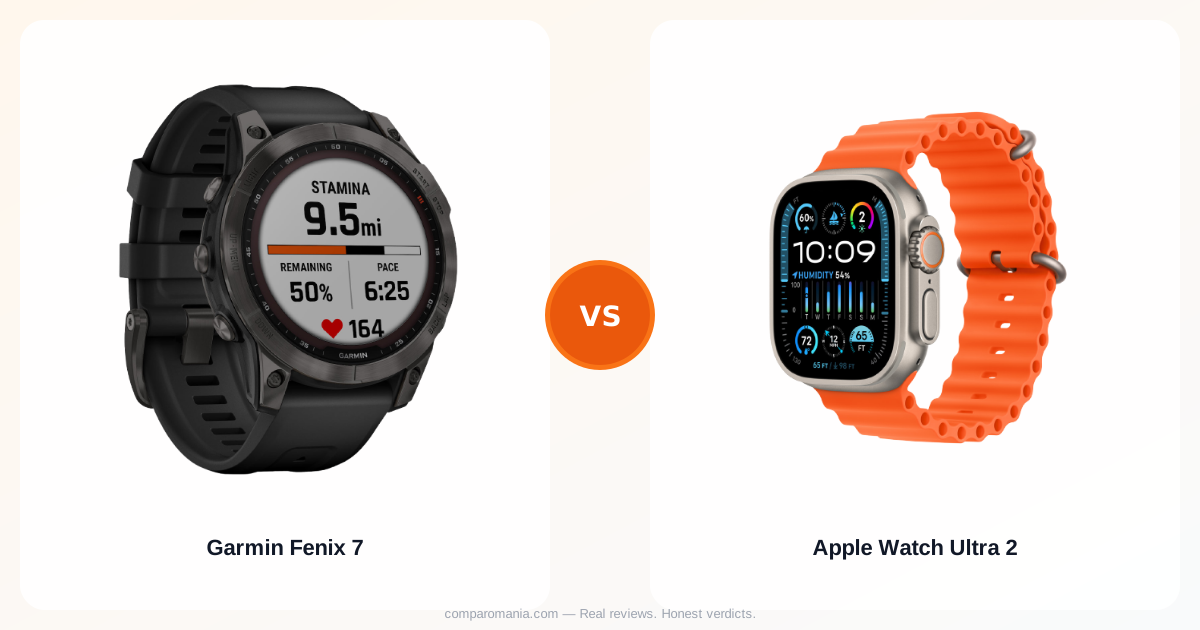
You've already spent an hour on the brand pages. Garmin says "unrivalled endurance." Apple says "built for the wild." Neither says what happens when you actually need the watch to work at hour 30 of a trail run, or whether it'll still sync your training data without a fight three years from now.
Here's what owners actually report.
What you're actually paying for in 2026
The Apple Watch Ultra 2 launched in September 2023 and retails at $799. In practice, you can almost always find a brand-new Ultra 2 at Best Buy for $150 to $200 off. The base Garmin Fenix 7 launched at $649, but with the Fenix 8 now current, Amazon has dropped the Fenix 7 to as low as $433, the lowest price ever seen, and the watch has been kept current with regular software updates. Step up to the Fenix 7 Pro Solar and the original $900 MSRP has collapsed to around $505 at various retailers in 2026.
So the actual gap today is narrower than the launch prices suggested. A discounted Ultra 2 at $599 versus a Fenix 7 Pro Solar at $505 is a $94 difference, not a philosophical one. What matters is what each dollar is buying.
The battery situation, told plainly
In standard smartwatch mode, the Fenix 7 lasts up to 18 days. In GPS-only mode it runs for 57 hours, and in expedition mode with solar charging that extends beyond 80 hours. The Apple Watch Ultra 2 offers around 36 hours in typical use and up to 72 hours in Low Power Mode with reduced functionality.
Those numbers are from Garmin and Apple respectively, so treat them as ceilings. Real-world GPS tracking on the Ultra 2 tells a harder story. With roughly 12 hours of GPS tracking, ultra-endurance athletes may want to look elsewhere. Users of other GPS watches are regularly surprised by how much charging the Ultra 2 demands, other watches, even cheaper ones, can last weeks, whereas the Ultra 2 can't make it two full days without Low Power Mode.
Software updates have made this worse at times. After installing watchOS 11 on the Ultra 2, multiple users reported the battery draining over 30% overnight, with watchOS 10 the same watch comfortably lasted two days. Those bugs eventually get patched, but they come back with the next update cycle.
The unhedged true thing: Apple's "rugged" watch is, fundamentally, a smartwatch
This is the structural observation nobody says clearly in the category. Apple built the Ultra 2 to handle the outdoors. Titanium case, sapphire crystal, 100m water resistance, EN13319 dive certification. Despite Apple's emphasis on ruggedness, the Ultra 2's core strength continues to be its smartwatch capabilities. That's not a criticism, it's a description. The watch excels at notifications, health data, ecosystem integration, and a display that outclasses almost everything else on a wrist.
But when OutdoorGearLab tested it against premium GPS competitors, they concluded that the battery life is almost annoyingly short, and the watch seemingly requires constant attention to avoid dying on you. The Fenix 7 was purpose-built for people who need the watch to outlast the activity. The Ultra 2 was built for people who want to bring their iPhone experience into the backcountry. Both are valid. Most buyers, though, discover which one they actually needed only after they've committed.
Build quality and how they actually feel
The Fenix 7 Pro has a rugged bezel and looks ready for anything, while the Watch Ultra 2, with its titanium body and jutting controls, has a sporty, gritty appearance. Both are genuinely tough. The Fenix 7's sapphire solar-charged display is scratch resistant, the case is fibre-reinforced polymer with a steel bezel, and it's been tested to military standards for shock, water, and thermal resistance.
The Ultra 2 comes in only one size: 49mm. The Fenix 7 Pro comes in three sizes, 42mm, 47mm, and 51mm, which matters more than it sounds. The Fenix 7X looks like a satellite dish on smaller arms. The Ultra 2 is also large, but it has no smaller option. If you have a narrower wrist, Garmin gives you a real choice. Apple doesn't.
The display is the Ultra 2's most obvious advantage. The S9 chip is faster, the display is measurably brighter, 2,978 nits versus 2,012 nits on the Fenix 7 Pro. Outdoors in direct sunlight, the Ultra 2's OLED is genuinely excellent. The Fenix 7's transflective MIP display is readable in every condition without ever needing to light up at full brightness, and that is exactly why the battery lasts as long as it does.
Training features and GPS accuracy
The Fenix 7 has all of Garmin's latest training analysis features, accurate sports tracking, excellent navigation with offline maps, music storage, and NFC payments. Garmin's Body Battery uses heart rate variability, stress data, and activity levels to estimate daily energy reserves, a metric athletes actually build training blocks around. Garmin Connect's depth of post-workout analytics is still wider than anything Apple Health offers.
Apple has closed the gap meaningfully on health sensors. The Ultra 2 is a strong recommendation for fitness enthusiasts, elevated by the user-friendly Apple Health app, which efficiently organises exercise, sleep, and daily heart rate data. For recreational runners and cyclists, it's more than enough.
For multi-day expeditions, the Fenix 7's GPS-only mode running for 57 hours, and beyond 80 hours with solar, is unmatched for reliability on long routes. On any extended trail run with the Apple Watch Ultra 2, carrying a portable charger is essentially mandatory, its battery won't survive most 100-mile races without external power. That's not a knock. It's just the cost of carrying the better smartwatch.
Ecosystem and long-term ownership
The Ultra 2 comes with LTE built in, there is no non-LTE version. The Fenix 7 Pro has no variant with mobile connectivity. If you want to leave your phone behind and still take calls or stream music on a run, only one of these watches supports it. But the Ultra 2's LTE lock means it only works with iPhone. Full stop.
Garmin works with both iOS and Android. It syncs to Garmin Connect, Strava, TrainingPeaks, and most third-party platforms without friction. If you're an Android user, the Ultra 2 isn't even in the conversation.
Long-term, both brands have real software concerns. Some Garmin users have grown concerned that premium Fenix 7 offerings are being passed over in favour of newer Garmin models. A thread titled "Garmin abandoned Fenix 7 Pro after 1.5 years" reached the top of the Garmin subreddit, with users pointing to features rolling out on Fenix 8 and even mid-range Forerunners while the Fenix 7 waited. Apple's update cadence is more predictable, though as noted, those updates occasionally trash battery performance for weeks at a time.
Who's actually buying each one
The Ultra 2 carries a 4.7/5 rating from over 2,700 Amazon reviews, reflecting users who value smart features and ecosystem integration more than extreme battery life. For dedicated athletes following structured training plans, endurance competitors, or adventurers exploring backcountry terrain for days at a time, Garmin justifies its premium with capabilities Apple doesn't provide, reflected in a 4.6/5 rating from over 1,500 reviews from users who understand they're paying for professional-grade tools.
The honest split: if you're training for an Ironman, running a 100-miler, or need a watch that lasts a week in the backcountry without a charger, the Fenix 7 is the tool for that job. If you want a watch that handles your health data, keeps you connected, looks good off the trail, and happens to be genuinely rugged, the Ultra 2 is better at that job than any Garmin.