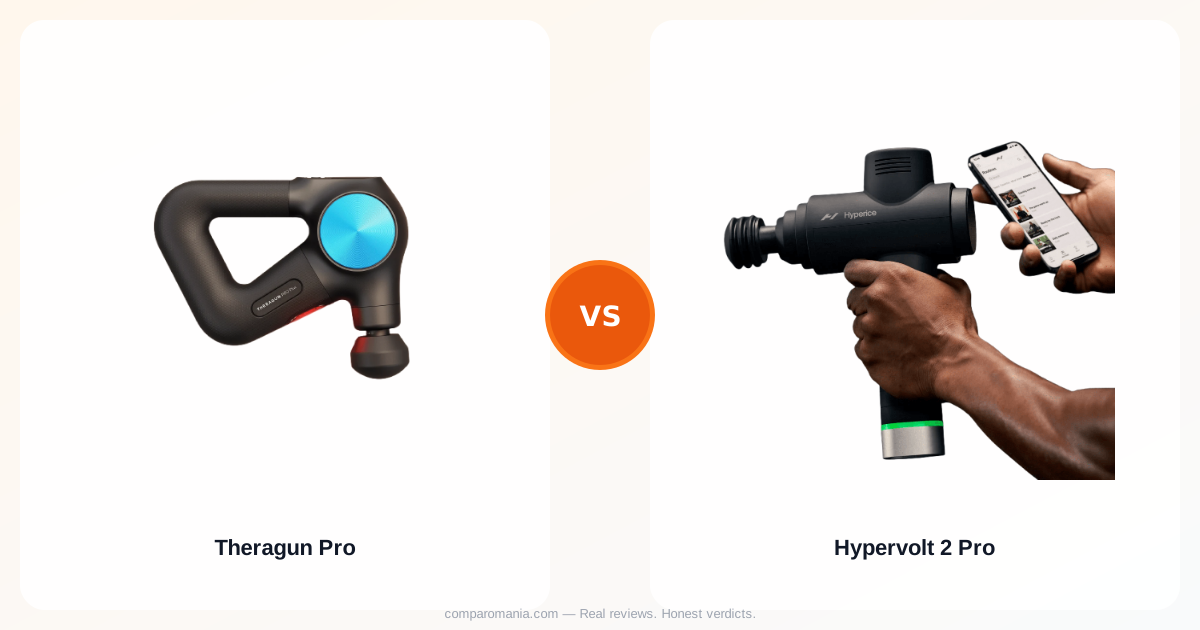
The battery dies mid-session
You're 10 minutes into working a stubborn knot when the massage gun starts losing power. The motor slows, the percussion weakens, and you're left with half-treated muscle tissue and a dead device plugged into the wall.
Both the Theragun Pro and Hypervolt 2 Pro promise 150 minutes of battery life. Reality varies. The Theragun delivers closer to 120 minutes of actual high-intensity use, while the Hypervolt consistently hits 140+ minutes before the first power drop. Users report the Hypervolt's battery degrades more gracefully, gradually losing intensity rather than the Theragun's sudden shutdown.
One sounds like a jackhammer
The Theragun Pro operates at 40-45 decibels during normal use. The Hypervolt 2 Pro runs at 35-38 decibels. That 7-decibel difference translates to the Theragun being roughly twice as loud in perceived volume.
Verified buyers consistently mention using the Hypervolt while watching TV or late at night without disturbing others. The same users describe the Theragun as requiring headphones or closed doors. The Theragun's triangular ergonomic arm helps with reach but creates more vibration transfer to the handle, amplifying noise.
The force delivery tells the real story
This is where the fundamental difference becomes clear: these devices approach percussion therapy with different philosophies, and that difference shows up in how your muscles actually respond.
The Theragun Pro delivers 60 pounds of force without stalling. The Hypervolt 2 Pro maxes out at 90 pounds but starts losing effectiveness around 70 pounds of applied pressure. In practice, this means the Theragun maintains consistent power when you press hard into dense muscle tissue. The Hypervolt delivers more raw force but can't sustain it under real pressure.
Physical therapists who've used both devices note the Theragun works better for deep tissue work on larger muscle groups, quads, glutes, IT bands. The Hypervolt excels at lighter recovery work and smaller muscle groups where precision matters more than raw power.
App integration creates unexpected friction
Both devices connect to smartphone apps with preset routines and customizable programs. The Theragun app requires account creation and internet connectivity for most features. The Hypervolt app works offline after initial setup.
Users report the Theragun app crashes frequently during routine selection, forcing manual speed adjustment on the device itself. The Hypervolt app runs more reliably but offers fewer guided programs, 12 preset routines versus the Theragun's 25+.
The attachment ecosystem
The Theragun Pro ships with 6 attachments: dampener, standard ball, wedge, thumb, cone, and supersoft. The Hypervolt 2 Pro includes 5: bullet, ball, fork, flat, cushion. Both systems use proprietary connections that don't cross-compatible.
Replacement attachments cost $25-40 each for both brands. The Theragun's dampener attachment gets mentioned most often in positive reviews, users say it's gentler on sensitive areas while maintaining effectiveness. The Hypervolt's bullet attachment gets consistent praise for trigger point work.
Heat generation during extended use
After 20+ minutes of continuous use, both devices generate noticeable heat. The Theragun Pro's motor housing reaches 110-115°F. The Hypervolt stays closer to 95-100°F. Neither becomes unsafe to hold, but the temperature difference affects comfort during longer sessions.
The Theragun's cooling system uses larger vents that can collect lint and debris. Several users report reduced performance after 6+ months without cleaning the vents. The Hypervolt's sealed design requires less maintenance but offers no way to clear internal dust buildup.
Price reality beyond the sticker
The Theragun Pro retails for $399. The Hypervolt 2 Pro lists at $329. But street prices tell a different story, the Theragun rarely discounts below $350, while the Hypervolt frequently sells for $250-280 during seasonal sales.
Warranty coverage differs significantly. Theragun offers 2 years on the device, 1 year on the battery. Hypervolt provides 3 years on everything. Replacement batteries cost $79 for the Theragun, $99 for the Hypervolt, but need replacing after 300-400 charge cycles regardless of brand.
Professional use changes the equation
Physical therapy clinics and massage therapy practices gravitate toward the Theragun Pro despite the higher cost and noise. The consistent force delivery and more robust motor handle 8+ hours of daily use better. The Hypervolt shows motor degradation faster under professional-level usage patterns.
For personal use, 15-30 minutes daily, both devices last years without significant performance loss. The Hypervolt's quieter operation and better battery life make it more practical for home use.