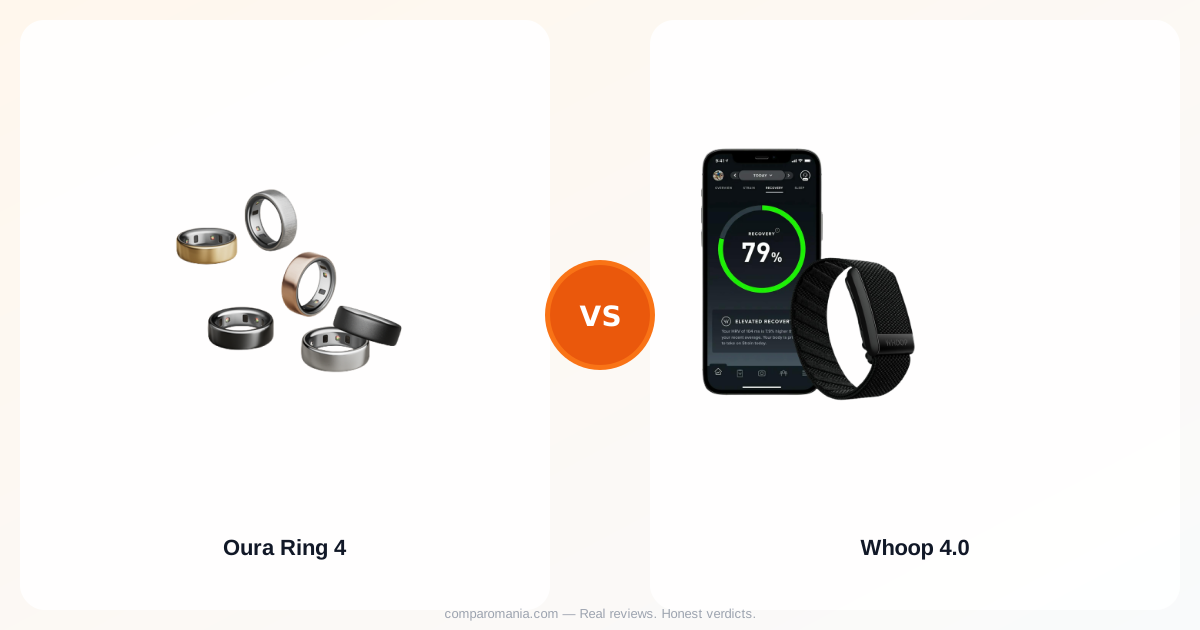
You bought the Whoop because every athlete you follow wears one. Or you're leaning toward the Oura because it looks like jewellery and nobody needs to know it's a health tracker. Either way, you've landed on the same problem: both cost real money, both require a subscription, and the brand websites tell you almost nothing useful.
Here's what they don't lead with. Neither of these is a cheap buy, and the one that looks cheaper at checkout often isn't by month eighteen.
What you'll actually pay over two years
The Oura Ring 4 starts at $349, plus a membership of $5.99 per month, or $69.99 if you pay annually. Over two years, that's roughly $489 all in on the annual plan. The Whoop 4.0 works the other way: the device is included in the membership, you pay annually and get the tracker with analytics. Monthly rates for existing members sit at $25/month for Whoop One, $30/month for Whoop Peak, and $40/month for Whoop Life.
Year one costs are almost identical, around $360–$365 for both. But after that first year, Oura drops to $72 annually while Whoop continues at $360 unless you buy a two-year membership. That gap compounds fast. By year three, Oura owners are roughly $600 lighter. Whoop owners, depending on tier, are closer to $900–$1,000 out of pocket, and they don't own the hardware outright in the same way, the Whoop device becomes non-functional if the subscription is cancelled. Continuous access requires ongoing payment.
The subscription trap nobody budgets for
This is the hidden cost nobody tracks. Both products position the subscription as a feature, access to insights, coaching, trend data. What they don't show you is what happens when you want to leave.
With the Oura Ring 4, you own a $349 titanium ring. Cancel the $5.99 subscription and you lose the detailed analytics, but the hardware still functions as a basic tracker. With Whoop, cancellation means the device stops working entirely. You've been renting all along.
When Whoop announced its 5.0, the company initially told members who wanted to upgrade that they could either extend their subscriptions by 12 months or pay a one-time fee of $49, despite the brand's model being built on the premise of higher subscription prices in exchange for free hardware upgrades. After customers complained, Whoop responded with a Reddit post announcing a more expansive upgrade policy, anyone with more than 12 months remaining on their subscription became eligible for a free upgrade. It resolved, but the episode showed exactly how much leverage the subscription model hands to the company, not the consumer.
Sleep tracking is where this actually gets decided
The Oura Ring 4 is widely regarded as the most accurate consumer sleep tracker available in 2026 for passive overnight use. That's not just marketing. A study conducted by researchers at Brigham and Women's Hospital evaluated the accuracy of sleep-staging algorithms across consumer wearables against gold-standard polysomnography and found that Oura Ring was the most accurate in four-stage sleep classification. Oura Ring had the highest sensitivity for deep sleep detection at 79.5%, and did not significantly underestimate or overestimate any of the four sleep stages, while Apple Watch overestimated light sleep by an average of 45 minutes.
A 2025 study specifically examining nocturnal HR and HRV found that Oura Ring Gen 3 and Gen 4 "consistently showed the strongest agreement" for both HRV and RHR measurements, outperforming Whoop, Garmin, and Polar, across more than 500 nights of real-world, home-based sleep data.
Whoop isn't bad at sleep. Whoop 4.0 tracks sleep extensively and removes wakeful periods to give a true picture of rest. It also monitors sleep need, calculated by comparing actual sleep to core needs, with additional requirements from strain added on top. The difference is that Whoop frames sleep as an input to athletic performance. Oura treats it as the primary metric.
One tester found the thick Whoop band irritating through the night, especially on hot summer nights, while the Oura Ring raised no comfort complaints. A ring on your finger simply moves less than a band on your wrist.
Workout tracking, where Whoop pulls ahead
Whoop positions itself as a performance tool for athletes rather than a general wellness tracker. Its sleep metrics are integrated into a daily recovery framework that includes a Strain Score for workout load and a Recovery Score for readiness. That framework is where dedicated athletes actually use it differently from Oura.
Whoop has a threshold of elevated heart rate before it initiates auto-detection of activity, and in testing it accurately detected a run versus a walk. One tester noted that the auto-detection accuracy meant they didn't have to think about starting their tracking. The Whoop 4.0 is also compatible with Whoop Body apparel, which allows wearers to position the sensor in different spots on the body, rather than only the wrist.
The lack of meaningful fitness performance tracking in real time, and the need for a second device if you run or cycle seriously, are real drawbacks, but within its lane, Whoop's strain framework is more developed than Oura's activity scoring. Oura tells you whether you recovered. Whoop tells you whether you should train hard today, and tracks the cost of doing it anyway.
There is something to be said for not having the distraction of a screen, but testers missed being able to monitor heart rate during hard uphill efforts or check accumulated vertical. Whether that matters depends entirely on how you train.
Design and daily wearability
The sensors in Oura's third-generation ring were raised and felt like little bumps, but the sensors in the Oura Ring 4 are flat, giving the ring a smooth interior that's more comfortable to wear. The Oura Ring 4 is built with an all-titanium frame with 18 sensing paths that intersect across the finger. It's available in twelve sizes and six colors.
User-reported downsides include the finish scuffing easily, worth knowing if you're considering gold or rose gold at the higher price points. The ring form factor is genuinely more discreet than a wrist band, which matters to people who wear it to client meetings or black-tie events.
Battery life was one of the documented pain points for Whoop 4.0 users, lasting only 3 to 5 days. Oura's battery runs up to eight days. The Whoop charges through a wearable battery pack that clips onto the band without removing it, convenient, but easy to misplace. Users reported complaints about the charging hardware being easy to lose and the short length of the charging cable.
Ecosystem and who each device is actually built for
Oura makes sense if sleep is the top priority, you don't want anything on your wrist 24/7, and you want lower long-term cost. Whoop makes sense if you train hard enough that strain coaching and detailed workout heart rate data matter.
The Gen 4 represents the most significant sensor hardware upgrade in Oura's history, with particular emphasis on measurement accuracy across diverse skin tones, a documented weakness of the Gen 3 that attracted criticism following independent audits in 2022–2023. That's a genuine improvement for users with darker skin tones, where optical sensor accuracy has historically varied across wearables.
Whoop pairs with third-party apps including Apple Health and some training platforms, but its proprietary strain and recovery scoring doesn't export cleanly. If your coach or training plan uses a different system, the data tends to live in a silo. Oura faces a similar limitation, the app reorganises data into tabs called Today, Vitals, and My Health, which works well as a standalone system but doesn't push granular data outward easily.
Neither plays particularly well with others. That's less a knock on both products and more a category-wide reality worth knowing before you commit.