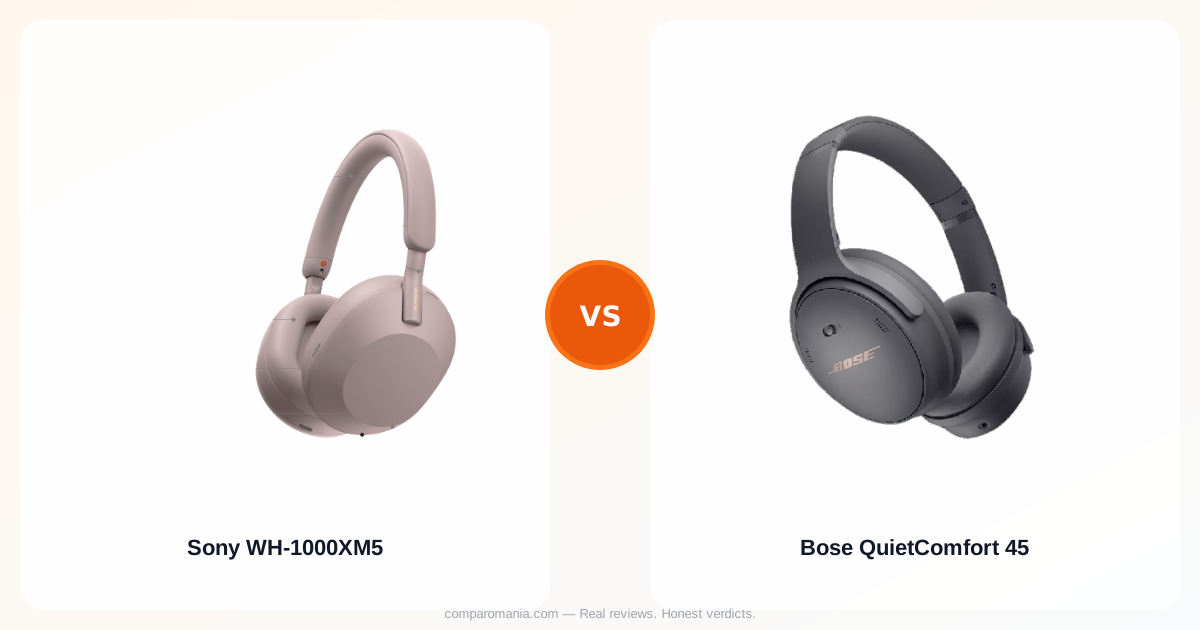
You've been on the same flight twice this month and you're tired of arriving wrecked. Or you work from a kitchen table that somehow faces the noisiest street in your city. Either way, you've narrowed it down to two headphones that are on every shortlist: the Sony WH-1000XM5 and the Bose QuietComfort 45. Both cost real money. Both have years of praise behind them. The decision shouldn't be this hard, but it is, because the difference isn't obvious until you're living with one of them.
What you're actually paying right now
The Sony WH-1000XM5 launched at $399/£380/AU$650, and that sticker price still sits on the box. Amazon has been selling them at $248 shipped across all four colours, nearly 40% off the list price. Costco has stocked them as low as $230. The WH-1000XM6 launched in 2025 and pushed the XM5 into discount territory, which is good news for buyers right now.
The Bose QC45 retails for less than $279 throughout the year. That gap used to be wider. At current street prices, you're looking at roughly $248 versus $279, close enough that price alone isn't the tiebreaker it once was.
Both are available globally through Amazon, the manufacturers' own sites, and major electronics chains. Neither is hard to find.
The noise cancellation gap is real, but smaller than you'd expect
Sony's XM5 uses eight microphones across two processors, specifically targeting high and mid frequency sounds, the voices, air conditioning hum, and office chatter that actually disrupts concentration. That's a measurable advantage over what the QC45 runs.
Despite being older, the Bose QuietComfort 45's noise cancelling performance holds up as nearly on par with top ANC headphones today, including the newer Bose QC Ultra and Sony WH-1000XM5. On a plane, on its quietest setting, the QC45 is extremely effective at reducing outside noise, even with jet engine noise in the background. So in real-world use, trains, cafes, planes, the QC45 is not falling short in any way you'd notice on a daily commute.
The one structural difference: the QC45 has no standard listening mode. You pick noise cancelling or Aware mode, either filtering out external noise or piping it in. The WH-1000XM5 lets you use it as a non-noise cancelling headset, which saves battery when you just want music without any processing. If you regularly switch off ANC to save battery on long days, that matters.
Sound quality: depends on what you want to hear
The WH-1000XM5 supports Hi-Resolution Audio and the LDAC codec. For Android users streaming at high bitrates, that's a genuine advantage. You'll hear a difference on well-mastered tracks through a service like Tidal or Amazon Music HD. iPhone users get no benefit from LDAC, Apple devices don't support it.
The QC45 takes a different approach. Acoustic architecture adds depth and fullness, and volume-optimised Active EQ keeps it balanced. What that means in practice is that the QC45 sounds good from the first second, at any volume, without touching an app. Many owners specifically mention it as the headphone that just sounds right without tuning.
The Sony WH-1000XM5 reigns as the better performer overall, but there are reasons to buy the QC45, including its default sound profile and portability. If you're an Android user who listens to lossless audio and wants to extract everything from that, the XM5 is the better tool. If you want something that sounds excellent immediately, the QC45 doesn't make you work for it.
The thing nobody says clearly enough about Sony
This is the structural observation that keeps mattering after the purchase: the XM5's hinge is a design flaw that Sony has not resolved, and buying these headphones means accepting a real risk of physical failure outside warranty.
The plastic hinges feel frail for a $400 headphone, and broken hinges are a widely-complained issue on Reddit. That's not forum noise. After about a year, the joint connecting the headband to the earpiece breaks, just outside the warranty period, which owners found to be a common issue after research. Sony has set up a headband repair service, but that costs around $150, money most people would put toward a different brand.
For some owners it becomes a question of when it will break, not if. The sound quality is excellent, but the hinge is the absolute Achilles heel. Sony's WH-1000XM5 struggled with widespread hinge defects, and a similar issue appears to affect the new WH-1000XM6. This isn't a one-off defect in a small batch. It is a recurring structural problem across two generations.
The QC45 doesn't have this issue. The QC45 build quality is very solid throughout, with metal underneath the plastic exterior. With impact-resistant glass-filled nylon in the headband and metal reinforcements, it's clearly made from plastic, but it's well built. Owners don't post about QC45s falling apart.
If you keep headphones for three or more years, this section is the one that changes the calculation.
Design and daily wearability
The QC45 weighs 240g and evenly distributes weight with plush ear pads and across the headband. That's the reason Bose has dominated the comfort conversation for years. Long-haul flights, full work days, the QC45 disappears on your head in a way that few headphones at any price manage.
The XM5 is also comfortable, but users on SlickDeals and forums note the thinner headband compared to the XM4 makes it less comfortable for long use. The ear cups are shallower, too, comfort isn't ideal for some users due to shallow cups, requiring frequent adjusting.
The QC45 folds neatly and comes with a compact hardshell case, clearly designed for frequent travellers who need to maximise bag space. The XM5 comes with its own case, but doesn't fold flat, it pivots, which takes up more room in a bag.
Features and ecosystem
The XM5 supports multipoint connection, letting you switch quickly between two devices. Touch controls on the earcups handle playback, volume, and calls, and Speak-to-Chat automatically pauses music when you start talking. The Sony Headphones Connect app also supports LDAC codec switching, custom equaliser presets, and Adaptive Sound Control that adjusts ANC based on your detected activity.
The Bose Music app handles setup, Bluetooth management, adjustable noise cancellation settings, and shortcuts. SimpleSync lets you pair the QC45 with any compatible Bose Smart Speaker, useful if you're in a Bose ecosystem. The QC45 has no equivalent surround sound or spatial audio customisation. It's a simpler headphone by design, which some people prefer and others find limiting.
One difference that catches people off guard: the Bose app doesn't let you fully turn off both noise cancelling and transparency mode, something Sony and Apple both offer. You're always running some form of processing, which eats into battery life with no way to disable it.
Battery life and long-term ownership costs
Battery life on the XM5 is 30 hours with Bluetooth and noise cancelling on. Turn off ANC and it extends to 40 hours. A ten-minute charge gives five hours of battery life.
The Bose QC45 lasts 24 hours 49 minutes with noise cancelling on in independent testing, slightly above Bose's own 24-hour claim. A quick 15-minute charge offers 3 hours when you're on the go. That's a meaningful gap over a week of daily commuting, you'll charge the QC45 more often.
The long-term cost picture is where things get uncomfortable for Sony. If the hinge breaks out of warranty, Sony's repair service runs around $150. One owner paid $400 for the headphones plus $50 for a warranty that didn't cover the hinge failure. The QC45's build record doesn't carry that same risk. Buying the XM5 at $248 still looks like a bargain until the hinge goes at month 14.