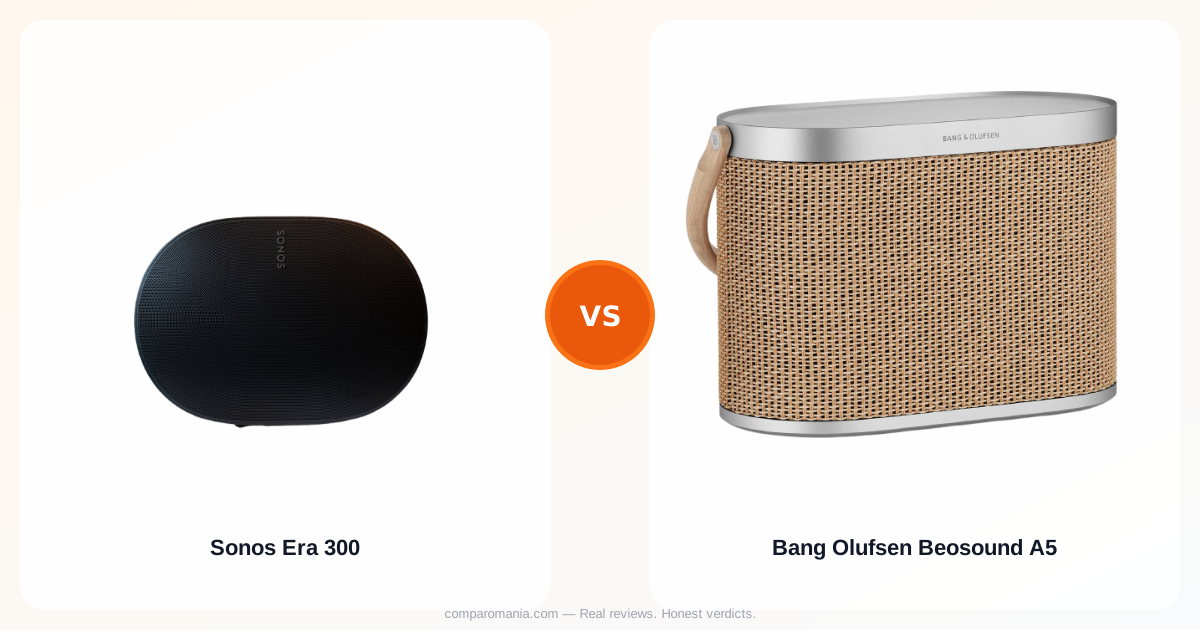
You've done the brand website research. You know the Era 300 has six drivers and the A5 has 280 watts of Class D amplification. Now you're trying to figure out whether those numbers actually mean anything different when you're sitting in your living room at 9pm with a glass of wine, or whether one of these speakers is going to quietly disappoint you three months after you've stopped second-guessing the purchase.
The price gap is the first honest thing to name. The Era 300 carries a full-price RRP of $449. The Beosound A5 starts at $1,099 in the United States, which makes it the most expensive battery-powered portable wireless speaker on the market, and by a distance. That's not a small gap to close with vibes.
The $650 gap is real, but the reasons matter
The Era 300 requires constant mains power, while B&O has managed to integrate a rechargeable battery into the A5 that delivers up to 12 hours on a single charge. That's not a minor footnote. You can carry the A5 between rooms, take it to the garden, bring it to a friend's place. The Era 300 stays where you put it, which is fine until you wish it didn't.
The Beosound A5 in Nordic Weave is $1,049, while the Dark Oak version costs $1,149. There's also a Spaced Aluminium variant. That version is priced at $1,399. So the A5 range actually spans $1,049 to $1,399 depending on finish. The Era 300 has no such variation, one price, two colours.
If portability isn't relevant to your setup, the A5's biggest functional advantage disappears immediately. Be honest about that before you read another word.
Spatial audio is the Era 300's whole identity
The Era 300 is a spatial audio speaker that pushes sound in almost every direction: forward, upward and to the sides, giving a wall-to-wall, floor-to-ceiling audio experience. That's not marketing, it's the speaker's physical architecture. The speaker's ability to fire out immersive, large-scaled audio in all directions comes from its six-driver arrangement, which justifies its hourglass shape.
Spatial audio tracks transform the music, and not in a gimmicky way, the speaker engages its top-firing drivers and bounces audio differently when playing spatial audio content. On Apple Music or Amazon Music, with a spatial-mixed album, the effect is genuinely different from conventional stereo. It's the one thing the Era 300 does that nothing else at its price comes close to.
The A5 takes a different approach. Its drivers are beam-forming to help create B&O's "Omni" sound, a 360-degree sound that aims to eliminate a listening sweet spot and push music across a wider soundstage, rather than create a spatial sound experience like the Sonos Era 300 delivers. Those are genuinely different goals. The A5 is trying to fill a room evenly. The Era 300 is trying to put you inside the recording.
The A5 slightly falls short of delivering a true 360-degree sound, though it does create a voluminous and organised soundstage. An immersive, enveloping sound is quite different from big sound, as anyone who's heard the Era 300 will know. You'll need to temper your expectations where this aspect of the A5's performance is concerned.
For spatial audio, there's no contest. For pure tonality, warmth, and controlled bass at volume, the A5 is the better-engineered speaker. TechRadar called the A5's sound quality "bloody phenomenal." The two speakers are solving different problems.
What Sonos doesn't put on the box
This is the structural observation this comparison can't skip.
In April 2024, Sonos announced a redesigned app, with CEO Patrick Spence stating it would be "easier, faster and better." Instead, it delivered chaos: speakers disappearing from systems mid-playback, volume controls becoming unresponsive, and entire music libraries vanishing.
The backlash resulted in lost stock value, millions in damages, layoffs, and the departure of CEO Patrick Spence and several other officers in early 2025. By July 2024, with complaints mounting, the company laid off 100 employees, 6% of its workforce. In May 2025, Sonos was hit with a class action lawsuit claiming the company falsely advertised the new app while failing to warn users of its "numerous defects" that would degrade device performance.
The hardware, the Era 300 itself, was never the problem. What changed is that what used to be a private, on-network wireless audio control system became a cloud-based controller that requires a round trip to Sonos servers to process and respond to local commands. You bought a speaker. You now depend on a company's server infrastructure to use it the way it was advertised.
Users who spent thousands on Sonos products over the years are openly questioning whether the company will be around long-term. That's not irrational fear. It's a reasonable thing to weigh when you're buying into any closed ecosystem.
Build quality and what it actually means to own one
Where Bang & Olufsen products are concerned, build quality is deeply impressive. The A5 is designed to look like something from 1961 and feel like it'll still be working in 2041. It has interchangeable parts, including the battery, individual speaker units, carrying handle and grille, and if you want to change the look over time, you can mix and match with grille patterns in other colours. A replaceable battery in a premium speaker is more unusual than it should be.
The A5 carries an IP65 rating, making it resistant to dust and water, suitable for both indoor and outdoor use. The Era 300 has no IP rating. Keep that in mind if you're thinking kitchen countertop or covered patio.
The Era 300's build is solid, not spectacular. The matte black finish is prone to showing fingerprints and dust. The hourglass shape is distinctive enough to be either polarising or a talking point, depending on the room. Neither speaker looks generic. But the A5 is built to age. The Era 300 is built to function.
Features and ecosystem fit
You can connect to the Era 300 over Wi-Fi and Bluetooth, and it syncs with other Sonos speakers in your home. If you already own Sonos hardware, an Arc soundbar, a Sub, another Era 300 as a stereo pair, the ecosystem argument for the Era 300 is real. Pairing two Era 300s gives you something approaching a full spatial audio rig at around $900 total. Paired with the Sonos Arc Ultra and Sub 4, the Era 300 delivers Dolby Atmos surround sound as a rear channel. That's a genuinely capable home theatre configuration.
The A5 operates on B&O's Mozart platform. It connects via Bluetooth 5.2 and Wi-Fi 6. The B&O Music app shows battery level, music source, and shortcuts to favourite radio stations, with five sound presets, Optimal, Party, Speech, Night, and Lounge, each adjustable using B&O's Beosonic graphic equaliser. That's a more accessible EQ system than most competitors offer. But the A5 doesn't integrate with other speakers the way Sonos does. It's a standalone device.
The Era 300 lacks Google Voice Assistant and Chromecast support, which can be a deal-breaker for users heavily invested in the Google ecosystem. The A5 doesn't support Chromecast either. Neither speaker is ideal for Google households.
The A5 has a wireless phone charger integrated into the top panel, which is a small thing that turns out to be genuinely useful. The Era 300 doesn't.
Long-term ownership costs
The Era 300 at $449 looks like a value play against the A5. Over three to five years, that framing gets complicated.
Sonos hardware depends on the Sonos app, which depends on Sonos existing and maintaining its server infrastructure. A longtime Sonos user with close to 30 devices across a decade of purchases concluded: Sonos is no longer what it used to be. That's not a one-off complaint. It's a structural concern about what you're buying into.
The A5's modular design changes that calculation. Its modular design allows key components, including the battery and streaming module, to be replaced or upgraded. A speaker that can be repaired rather than discarded carries a different five-year cost than one tied to a platform with leadership instability. B&O's stated goal is to make products that last, both in terms of quality and design, as a sustainability commitment.
Neither speaker is cheap to repair out of warranty. But one of them was designed with repair in mind, and one of them requires a functioning tech company to deliver the experience you paid for.