You scheduled the clean for 9am, left for work, and came home to the robot wedged under a chair, dustbin half-full, three rooms untouched, app showing a triumphant "cleaning complete." If that's happened once, you already know that buying the right robot vacuum matters more than any brand story suggests.
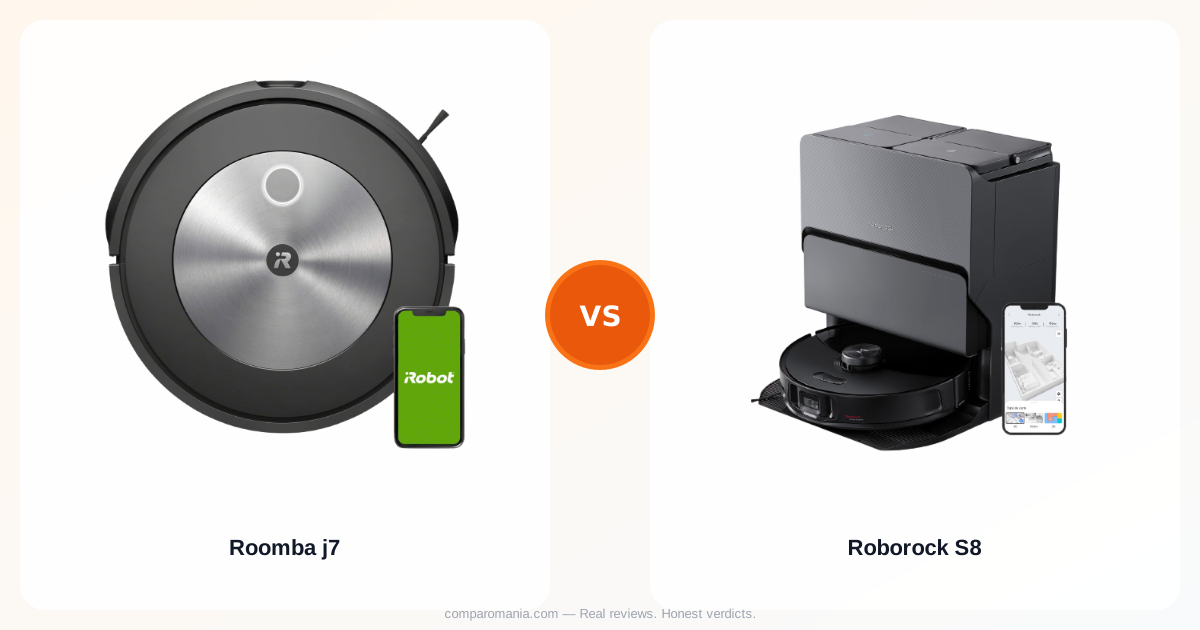
The Roomba j7 and the Roborock S8 are the two names that dominate the mid-to-upper tier of this category. Both run around $400–$750 depending on which version you buy and when you catch a sale. Both promise hands-off floors. But they are built around different priorities, and getting that distinction wrong costs you money and patience.
Price gap is smaller than it looks
The base Roomba j7 (model 7150, without a self-emptying dock) is listed on Amazon at around $339 as of early 2026. The j7+ with the self-emptying base runs $749 on the same platform. The Roborock S8 with its sonic mop has sold for as low as $420 during promotions at Amazon, Walmart, and Roborock's own store, with the S8+ (which adds the auto-empty dock) priced higher than the base S8.
So if you're comparing base unit to base unit, the j7 is cheaper. Compare self-emptying to self-emptying and the gap narrows considerably. The Roborock S8+ was selling for around $550 during mid-2024 sales, against the j7+ at $469–$749. Neither is a bargain category; you're spending real money either way.
The mopping question, answered plainly
The Roomba j7 doesn't mop. The base j7 is a vacuum only. There's the Combo j7+ variant that adds a mop, but the standard j7 and j7+ don't include it.
The Roborock S8, by contrast, was built from the start as a combined unit. Its sonic mop vibrates at 3,000 oscillations per minute, which actually scrubs dried-on coffee splatter and food residue rather than just dragging a damp cloth across the floor. The auto-lift system raises the mop pad when the S8 detects carpet, which works reliably enough that most owners stop thinking about it after the first week.
If you have a mix of hard floors and carpet and want one machine to handle both, the S8 wins this category with no close contest. If you have mostly carpet, or you don't care about mopping, the j7's vacuum-only focus isn't a weakness, it's just a different product.
Obstacle avoidance: where the j7 still leads
The Roomba j7's PrecisionVision camera system identifies and avoids pet waste, shoes, and cords with best-in-class accuracy. iRobot backs this with their P.O.O.P. guarantee: the Pet Owner Official Promise means if the j7 runs over pet waste, iRobot will replace it for free. That's a real financial commitment to a real claim.
Where the S8 falls short is obstacle avoidance. The S8 uses 3D structured light and infrared imaging for its Reactive 3D Obstacle Avoidance system, which works in both bright and dark rooms. But real-world performance has limits. Six-month owners have reported the Roborock sucking up socks found underneath furniture, and failing to see plant runners that had stretched out onto the carpet.
The j7 is well-regarded enough that owners describe it as the first robot they could schedule without worrying much. That confidence is specific and earned. The S8 gets most obstacles, but "most" isn't the same as the j7's track record with pet waste in particular.
Navigation and mapping in practice
The entire Roborock S lineup uses LDS laser (LiDAR) to map and navigate your home. LiDAR doesn't rely on ambient light, which means the S8 maps just as accurately at night or in a dark room as it does in daylight. Owners who've switched from Roomba to Roborock frequently cite better mapping and the ability to operate well without lights turned on.
The j7 uses camera-based visual SLAM navigation, which is capable but light-dependent. Some j7 owners report the robot acting erratically on tile floors, circling repeatedly before throwing error codes related to cliff sensors, a known issue with high-contrast floor transitions and shadows. It doesn't happen to everyone, but it's common enough to be a documented pattern.
For multi-room homes with mixed lighting, the S8's LiDAR gives it a genuine edge. Smaller, well-lit apartments won't notice the difference much.
What real owners actually run into
Both robots have recurring complaint patterns that don't show up in review scores.
On the j7 side: owners report the robot stopping frequently with a "clean the brushes" error, combined with the self-emptying dock failing to empty reliably. Amazon reviews show a mixed picture, with praise for features alongside reports of getting stuck and mapping problems. Some owners who upgraded from the older i7 found more issues with the base not communicating properly and the bin not emptying.
On the S8 side: at least one Roborock owner reported the side brush motor failing after approximately 13 months of use despite following all maintenance recommendations, noting it didn't appear to be a maintenance issue. The vacuum also consistently left visible debris, especially pet hair clumps, even on high suction with no clogs present. Connectivity issues with the app are among the more common complaints from S8-series owners.
Neither robot is bulletproof. The j7's problems tend to cluster around the self-emptying dock. The S8's problems are more spread across hardware and software.
The thing nobody in the category says clearly
On December 14, 2025, iRobot filed for Chapter 11 bankruptcy, with the goal of selling the company to Shenzhen Picea Robotics and Santrum Hong Kong. The Roomba j7 is still sold on Amazon, but long-term warranty support is uncertain.
This matters more than the spec sheet comparison. iRobot stated the bankruptcy is not expected to impact app functionality, customer programs, or product support, but that's the pre-restructuring statement, not a binding long-term guarantee. The company completing Chapter 11 under new Chinese ownership is a different business than the iRobot that built the j7's reputation. Software updates, replacement parts, and warranty claims all depend on decisions made by new owners whose priorities are unknown.
Roborock Technology Co., Ltd., based in Beijing with revenue exceeding $1.2 billion in 2024, carries no equivalent supply chain risk. The company is financially stable and expanding. Buying a j7 right now means betting that the ownership transition goes smoothly enough to keep the product viable for three to five years. That's a real bet, and most listings don't mention it.
Long-term ownership costs
Both robots need consumables: filters, brushes, and bags or dust collection bins. Neither brand is cheap on replacements, and both have parts that wear on a 6–12 month cycle depending on usage.
The j7's self-emptying dock uses a sealed bag, which is more hygienic than open-bin systems for allergy sufferers. The bags themselves cost around $15–$20 for a pack of three, and you'll go through them every two to three months under normal use. For the S8 with its self-emptying dock, the bag economics are similar.
Where things diverge is repair. At least one Roomba owner reported their unit stopping working after 18 months, with iRobot quoting half the cost of a new unit for repair. With the bankruptcy, that repair infrastructure is now in transition. Roborock's service network isn't without its problems, with owners reporting navigation failures requiring multiple service center visits, but the company itself isn't going anywhere.
The S8's mopping adds a maintenance variable the j7 avoids entirely, the mop pad needs replacing, and if you don't keep it clean, the results can include streaks rather than clean floors. That's a real cost in both time and money that the vacuum-only j7 sidesteps.