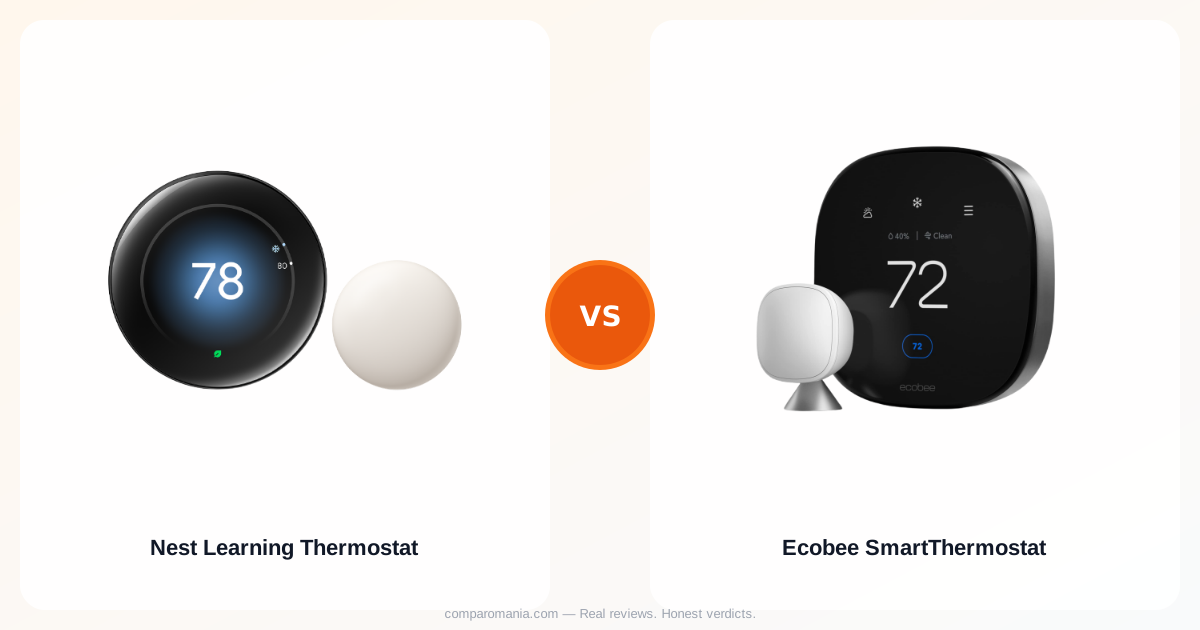
You've got the compatibility checker open in one tab and a Reddit thread from six months ago open in another. You're not confused about price, $279.99 for the Nest 4th Gen versus $249.99 for the Ecobee SmartThermostat Premium isn't the hard part. The hard part is that both devices sound reasonable and you can't tell which one actually fits the home you live in.
That's what this piece is for.
The price gap is real, but it's not the whole story
The fourth-generation Nest Learning Thermostat retails at $279.99 and includes a remote room sensor. The Ecobee SmartThermostat Premium sits at $249.99 MSRP and also ships with a SmartSensor. So you're $30 apart at retail, which sounds close until you look at what each sensor actually does.
The Ecobee's included sensor is older but more advanced, it detects occupancy in a room and tells the thermostat to stop targeting temperature preferences when the space is empty, avoiding wasted energy. The Nest's bundled temperature sensor reads temperature. That's it. No occupancy detection. At $249.99 versus the Nest's $279.99, the Ecobee costs $30 less while including a SmartSensor with occupancy detection, a built-in air quality monitor measuring VOCs, eCO₂, and humidity, a built-in Alexa speaker, and a 3-year warranty.
On straight hardware-per-dollar math, Ecobee wins this section without much of a fight.
Nest's design is the one you'll keep staring at
The fourth-generation Nest comes in Polished Gold, Obsidian, or Silver, and sports a larger 2.7-inch display with a resolution of 600 by 600 pixels, up from the 2.1-inch, 480-by-480 display on the third-gen model. The display is bordered by a thin stainless steel bangle used to adjust temperature and scroll through menus. It's the rare wall-mounted device that people actually notice as an object.
The Ecobee uses a rounded square design and looks good on most walls, but it's only available in one color, black, while the Nest comes in three finishes. Ecobee adopted a zinc body and large touchscreen with rounded edges, and it's thick but fits a lot of information on the display, from the week's weather forecast to a live stream of a compatible video doorbell. Functional, not beautiful.
One real installation gripe with the Nest: the gray-on-gray printing that identifies each wire socket is very difficult to read, even in good light. That's a sloppy detail on a $280 device. But once it's on the wall, nothing else in this category looks like it.
What the installation process actually involves
According to Google, most homes won't need a C-wire when installing the Nest Learning Thermostat 4th Gen. The Ecobee requires a C-wire connection or the included Power Extender Kit, which means most people will find installation slightly more involved than with the Nest.
But here's the thing, the C-wire claim from Google has a quiet asterisk. When wiring the Nest 4th Gen, connecting the C-wire is recommended despite Google's assurances, because there are documented reports of problems with HVAC systems when the thermostat scavenges power from other wires instead. A small but notable subset of homeowners upgrading from a 3rd gen without a C-wire have encountered setup issues caused by an undocumented voltage requirement change.
So both devices effectively want a C-wire if you want a stable install. The Ecobee just says so upfront.
The false solution everyone reaches for first
Most people buying a smart thermostat assume the learning feature is what they're paying for. They picture the device quietly observing their habits, building a schedule, and saving money without any input. Both products market this heavily.
The honest version: smart thermostats often save 10–15% versus basic programmable models, but you'll see the biggest gains when your schedule is consistent, that's when the learning features actually earn their keep. If your household runs irregular hours, shift work, remote days, kids home half the time, the algorithm keeps chasing a moving target and you end up manually adjusting more than you planned.
The learning engine is real. The "set it and forget it" premise it implies is not.
Features: Ecobee does more, Nest thinks harder
The Ecobee SmartThermostat Premium includes indoor air quality monitoring, built-in voice control and speakers, hands-free calling, Bluetooth streaming, and smoke alarm detection. The air quality monitoring measures VOCs, CO₂, and humidity right from the thermostat display. For anyone who already has a connected home with multiple platforms, that's a meaningful list.
Google claims the Nest 4th Gen can save up to 31% annually on heating and cooling costs, while Ecobee's verified savings figure is up to 26%. The gap in claimed savings is worth noting, though both companies measure this differently and real-world results depend heavily on your home's layout, climate, and usage pattern.
Ecobee Premium gives you more built-in hardware, speakers, air quality sensing, radar occupancy detection. The Nest has a smarter scheduling algorithm and doesn't need a C-wire in most standard setups. Those are genuinely different value propositions, not just feature lists.
The Nest's most significant gap versus the Ecobee Premium is the absence of indoor air quality monitoring. The Nest's smart ventilation feature checks outdoor air quality and brings in outside air when conditions are favorable, but it doesn't track indoor VOCs, CO₂, or humidity the way the Premium does.
Ecosystem and compatibility, this is where your existing setup decides
The Nest 4th Gen adds Matter support, improved energy-saving algorithms, and a higher-resolution display. Matter matters here, it means the Nest can talk to Apple Home, Alexa, and SmartThings without forcing you into Google's app. The Nest connects to Apple HomeKit via Matter rather than natively, which works but adds an indirect layer.
The Ecobee SmartThermostat Premium has a longer track record of native HomeKit integration and includes Siri built directly into the thermostat itself when paired with a HomePod. For Apple-first households, the Ecobee generally delivers a smoother, more deeply integrated HomeKit experience.
Ecobee offers the broadest multi-platform compatibility overall, including SmartThings and IFTTT. The Nest handles Google Home, Alexa, and HomeKit through Matter, but SmartThings and IFTTT are not supported.
Google ended support for the 1st and 2nd gen Nest Learning Thermostats in October 2025 and pulled out of the European thermostat market entirely, which is worth knowing if you're buying outside North America. The Nest 4th Gen is currently a North America-focused product. The Nest 4th Gen's inbuilt motion detection, remote sensor, and AI features are available only for users in the US. Ecobee ships and supports its products in Canada and the US, with broader regional availability.
If you're in Google's world already, the Nest is a natural extension. If you're not, or if you're outside the US, Ecobee is the less complicated path.
Long-term ownership: the cost nobody talks about
The Nest's warranty is 2 years, the shortest in this category. Both Ecobee models offer 3-year warranties. For a device that costs roughly the same as the Ecobee Premium, the shorter coverage is a real disadvantage.
There's also the question of software longevity. Ecobee's ongoing software upgrades allow all its smart thermostats to evolve with customer needs, delivering continuous improvements and new features for years after purchase. Google's track record here is mixed, the 1st and 2nd gen Nest Learning Thermostats both eventually lost support, which is just product reality in consumer tech, but it's worth carrying that pattern forward when spending $280.
Ecobee thermostats are hardwired, so you never have to worry about losing control or replacing batteries, a genuinely underrated quality-of-life point. Nest uses a battery that charges via the wiring, which works fine but occasionally needs manual intervention when power supply issues arise.
The extra year of warranty alone is worth real money on a $250 device.