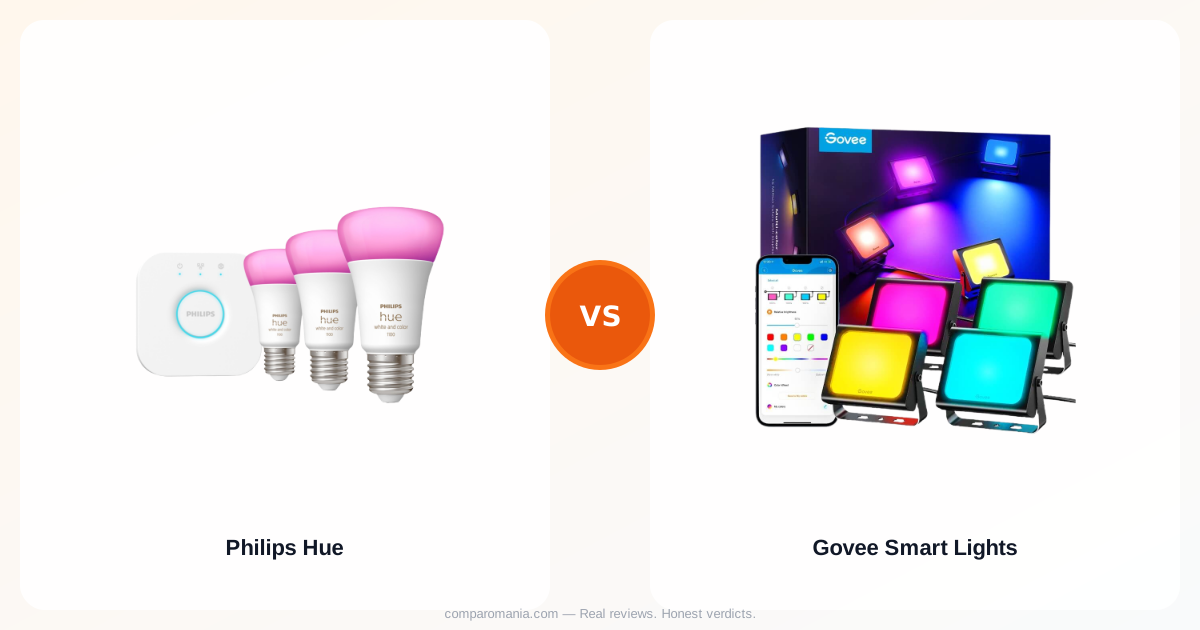
You've priced up a Philips Hue starter kit, seen the $130–$220 price tag, and found yourself staring at a Govee bulb listing for $57. The specs look close enough. The reviews are mostly five stars either way. So you close both tabs and do nothing, because spending that much on lights you're not sure about feels worse than the problem you started with.
That's exactly where this comparison picks up.
What you're actually paying at entry
Hue 2-pack and 4-pack starter kits including the Bridge typically list between $130 and $220 at full price, though promotions can push some kits below $120. That's not for a whole house. That's your first room. A single Hue A19 color bulb pushes up to roughly 810–1,100 lumens depending on the variant, draws about 8–10 W, and replaces a 60–75 W incandescent equivalent. The hardware is genuinely good. But the Bridge, which Philips requires for full functionality, costs around $50 separately, and it's often bundled into starter kit pricing rather than listed transparently.
Govee's A19 Smart RGBWW Bulbs (E26, 1200 lumens) list at $56.99, discounted from $79.99. No hub required. Connecting a Govee to a Wi-Fi network is easy, and the bulbs work without needing a hub, which makes the system better value for money compared to Philips Hue and other brands that require hubs to function.
On pure entry cost, Govee wins by a wide margin. But entry cost is only one chapter.
The app experience people don't warn you about
Hue's app has had years to mature, and it shows. Owners report that Hue lights "just work and stay working," with some users saying they haven't had a single issue with the app in years. That's not marketing copy, it's the kind of thing people say after they've tried the alternatives and come back.
Govee's app story is more complicated. Compared to the Philips Hue app, the Govee app has lacked the same responsiveness, instead of instantly turning lights on and off, users have reported looking at loading screens for longer than expected. After three years of use, some owners have found workarounds that make the Govee app nearly as fast as Hue's. That sentence should give you pause. Three years to find a workaround for a basic function is a long time.
To Govee's credit, the Govee Home app isn't guilty of being overly complex or clunky, it provides a user-friendly experience that's simple to navigate between features. The issue is latency on commands, not confusion in the UI. For gaming and entertainment setups where responsiveness matters less than color variety, you may not notice. For everyday use, where you're flicking lights on and off a dozen times a day, you will.
Light quality and color accuracy
Philips Hue is recognised for best-in-class color accuracy and dim-to-warm whites, with Alexa and Google voice commands working flawlessly and HomeKit automations running locally even if the internet drops. That local processing detail matters more than most people realise, your lights keep working during an outage, independently of the cloud.
One reviewer scores Govee at 6/10 on color accuracy compared to competitors, noting that WiZ edges it ahead for everyday white light use. Govee's color range is wide and vivid, the brand's RGBIC segmented strips and panels produce effects you simply can't get from Hue at comparable prices. But accurate, natural white light for reading or working is a different ask, and Hue wins that category clearly.
Brightness on Govee bulbs isn't quite what it should be when displaying colors other than white and yellow. For ambient effects and gaming setups, this matters less. For a home office or a kitchen, it's a real limitation.
Hue's build quality feels premium, with a smooth matte finish that diffuses light evenly without hotspots. Govee's hardware is functional but not remarkable, the value is in the features and price, not the physical object.
The cost nobody tracks until year three
Here's the thing the smart lighting category never says clearly: buying into Hue at $130 is not the spend. It's the first spend. Every additional bulb you add runs $25–$50 individually. Equipping a living room, two bedrooms, a hallway, and a kitchen with full-color Hue bulbs can easily run $400–$600 in hardware alone, not counting the Bridge. Individual Hue A19 bulbs street-price at $42–$50 each, with starter kits including the Bridge from around $179.
Govee's per-unit cost is lower at almost every price point, and the absence of a mandatory hub means you're not paying a fixed $50 just to unlock remote access. This saves $50–$60 compared to Philips Hue, which requires the Hue Bridge for full functionality. Spread across a whole home, that gap compounds fast.
The counterargument is that Hue bulbs are rated for 25,000 hours, and the ecosystem rarely forces you to replace working hardware. The value case for Hue is "pricey, but unmatched polish and longevity." Whether that longevity justifies a 3–4x per-bulb premium versus Govee is the question each buyer has to answer honestly based on how many rooms they're lighting, not just one.
Ecosystem depth and smart home integration
Philips Hue's ecosystem is enormous, including smart bulbs for almost every light fitting, LED strips, string lights, lamps, wall fixtures, floor lamps, outdoor lights, and more, plus smart switches, smart plugs, contact sensors, and even security cameras. If you want to build a complete smart home from a single brand, Hue is the only lighting company where that's genuinely achievable at scale.
Hue supports Matter, Zigbee, Bluetooth, and Wi-Fi Bridge connectivity, and works with Alexa, Google Home, Apple HomeKit, and Samsung SmartThings. In a 30-day stress test, Hue recorded zero drops using the Bridge. That's the Zigbee mesh advantage, Wi-Fi bulbs connect directly to your router and can cause congestion, whereas Zigbee lights use a separate mesh network that is faster and more reliable.
Govee's ecosystem story is more recent and patchier, but improving fast. At CES 2026, Govee's flagship products, the Floor Lamp 3, Ceiling Light Ultra, and Sky Ceiling Light, are all Matter-compliant and Apple Home compatible, and the company announced a new partnership with Samsung SmartThings for ecosystem integration. Govee devices do not natively support Apple HomeKit across their entire product lineup, but some newer models offer Matter compatibility, while others still require third-party solutions like Homebridge or Home Assistant.
The honest read: Govee is catching up, but only on its newest hardware. If you own Govee lights from 2022 or 2023, HomeKit access likely involves a workaround, not a settings toggle.
Where Govee genuinely wins
Govee's selection has a focus on fun, the real stars are products like the Govee Curtain Lights, Govee Glide Hexagon Light Panels Ultra, and the Govee LED Strip Light M1. These have no real Hue equivalent at comparable prices. Hexagon light panels, music-reactive strips, TV backlights, Govee's entertainment and gaming range is where the brand actually has an edge, not just a price advantage.
Govee's TV backlights use a camera to capture what's happening on the screen rather than HDMI. The system is cheaper, but the camera-based input means color reproduction isn't always as accurate and there may be some latency compared to the Philips Hue HDMI sync approach. If you're building a cinema room and color precision matters, Hue's Play Sync Box and light bars are meaningfully better. If you want immersive TV lighting on a budget, Govee is the answer.
Govee lets you automate your daily routine, sync lights with music, and bring exceptional versatility to your space at a price point that makes covering a whole apartment feel achievable in one purchase rather than a phased multi-year project.
Long-term ownership: what changes after year one
Hue's hidden strength only becomes visible over time. The platform receives regular firmware updates, the Zigbee mesh network means adding devices doesn't degrade performance, and Signify (Hue's parent company) has a track record of maintaining backward compatibility. Hue offers a vast ecosystem of switches, sensors, and outdoor lighting, allowing users to build a complete smart home environment where all components work together.
Govee's long-term story is less certain. The brand moves fast, which means product lines get replaced quickly and older devices sometimes lag on app support. For the many Govee devices that are not Matter-compatible, third-party solutions provide alternative pathways, but those pathways require technical confidence and ongoing maintenance. Not a dealbreaker for a home assistant enthusiast. A real friction point for anyone who just wants lights that work without tinkering.
The other factor: Govee rates some of its products at a 50,000-hour lifespan, which on paper matches or exceeds Hue. Whether that translates into practice over a five-year ownership window is harder to verify, and the community data isn't as deep as it is for Hue, which has a decade-plus of real-world installations behind it.