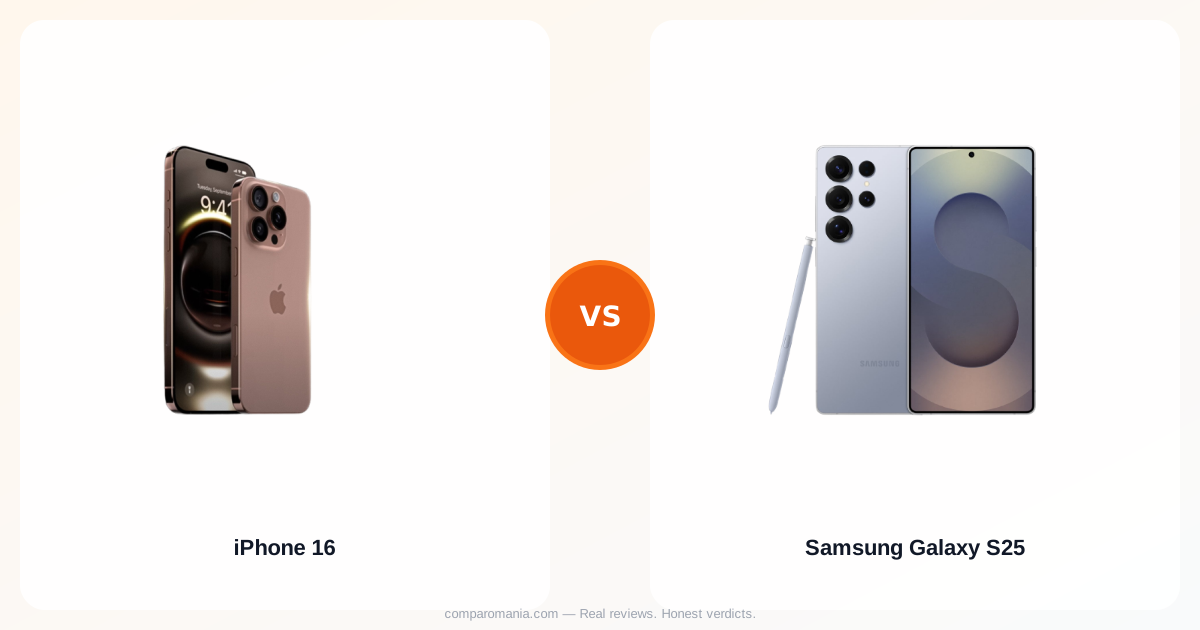
You're standing at $799 and can't go higher. You've been on both brand sites, read the spec sheets, and you still don't know. The numbers look close. They are close, and that's exactly what makes this frustrating.
Both the iPhone 16 and the Samsung Galaxy S25 launched at $799 for 128GB. Same price, same category, but genuinely different phones. The gap between them is real, and it falls in specific places.
Both cost $799, but one charges you more later
The Galaxy S25 held its $799 price at launch, and extra storage is significantly cheaper: the 256GB version costs $859, just $60 more than the base model. The iPhone 16 also starts at $799 for 128GB, but the 256GB model adds $100, and a 512GB version runs $1,099. That $40 difference at the 256GB tier isn't enormous, but it signals a pattern: Apple charges more at every step up the storage ladder.
At launch, Samsung typically beats Apple with tempting trade-in offers and doubled-for-your-money storage. If you're buying at full retail without a trade-in, both phones land at the same opening price. But once you need more than 128GB, and most people do within a year, the S25 keeps more money in your pocket.
The screen difference isn't subtle
The Galaxy S25 runs a Dynamic AMOLED panel at 120Hz with a peak brightness of 2,600 nits. The iPhone 16 uses an OLED panel capped at 60Hz, with 2,000 nits peak brightness. That 60Hz ceiling on the iPhone 16 is harder to ignore once you've used a 120Hz display for a week. Scrolling feels noticeably stickier, animations less fluid.
The S25's adaptive 120Hz refresh rate gives it a clear edge over the locked-in 60Hz display Apple continues to use on its entry-level flagship. Apple reserves 120Hz for the Pro models, which start at $999. So if smooth scrolling matters to you and $799 is your budget, the S25 is your only option here.
The Galaxy S25 features a Dynamic AMOLED 2x display compared to the iPhone 16's Super Retina XDR, making the S25 the stronger display by most technical measures. Whether you'd notice in daily use depends on what you're doing. Video and gaming: yes. Email and texting: probably not.
Cameras: more lenses versus better processing
The Galaxy S25 includes a dedicated telephoto lens for true optical zoom, a feature the base iPhone 16 is missing. That's a hardware gap you can't close with software. The S25's triple camera system gives you flexibility the iPhone 16 simply doesn't offer at this price.
But more lenses don't automatically mean better photos. For the most reliable point-and-shoot camera for video and consistent photos, the iPhone is still considered top of the class. Apple's image processor produces natural-looking photos and videos that users consistently prefer straight out of camera, without editing. Samsung's colours have historically skewed more vivid, which some love and some find overdone.
The S25 has a 50MP main camera versus the iPhone 16's 48MP, and both feature a 12MP front camera. On paper, near-identical. In real-world daylight shots, the difference is marginal. Where the S25 clearly wins is zoom and versatility. Where the iPhone wins is video consistency and colour fidelity.
If you shoot a lot of video, the iPhone. If you shoot a lot of stills at varying distances, the S25.
What the spec sheets don't tell you about performance
Here's the unhedged true thing, and it applies specifically to AI features: Apple sold the iPhone 16 as a phone "built from the ground up" for artificial intelligence. The reality of the rollout was slower. The iPhone 16 launch was considered underwhelming by some, partly because Apple fumbled the software rollout, features promised at launch weren't delivered until months later. Apple Intelligence features still need refinement before they match what Galaxy AI is capable of doing, according to testing.
The chip story is more nuanced. In GeekBench 6 single-core tests, the iPhone 16's A18 chip scores 3,264 versus the S25's Snapdragon 8 Elite at 3,132, a narrow iPhone lead. In multi-core, the S25 scores 9,935 against the iPhone's 7,899. Translation: the iPhone feels snappy on individual tasks. The S25 handles heavier parallel workloads better. For most users this difference is invisible. For power users running multiple demanding apps, the S25 has the edge.
Reviewers who tested both found they could do more with the S25's software than the iPhone 16, with Galaxy AI features described as more refined in real-world experience.
Battery and build: one clear, one genuinely close
The Galaxy S25 carries a 4,000 mAh battery; the iPhone 16 has a 3,561 mAh cell. Real-world tests show the S25 often outlasts the iPhone 16 under heavy use, though the iPhone 16 delivers solid all-day battery life for most people, power users may reach for a charger by late afternoon.
On charging speed, the gap is tighter than the battery size suggests. The S25 supports 25W wired and 15W wireless charging. The iPhone 16 supports 27W wired and 25W wireless via MagSafe. The iPhone actually charges faster wirelessly, which matters if you use a MagSafe pad. Wired speeds are effectively identical.
Build is where things get interesting. The S25 weighs 162g; the iPhone 16 weighs 170g. One Reddit reviewer described the S25 as "stunningly light and very comfortable to use." Both carry IP68 water resistance. The S25 uses Gorilla Glass Victus 2 on the back; the iPhone 16 uses Apple's Ceramic Shield on the front. Neither has a clear durability advantage in normal use. The design difference mostly comes down to whether you prefer a flat-edge frame or a more curved feel.
The battery gap is real enough to matter on long travel days. The charging story is more of a draw than it first appears.
Ecosystem and long-term ownership
This is where the decision shifts for a lot of people, and it shouldn't be ignored. If you already use a Mac, iPad, Apple Watch, or AirPods, the iPhone 16 earns its keep through Continuity, Handoff, AirDrop, and iMessage. None of that translates to Android. Switching costs are real.
Most iPhones receive between 6 and 8 years of major iOS updates from their release date, with an average of roughly 7 years. The Galaxy S25 is committed to up to 7 OS updates. Samsung has closed the gap meaningfully here, for years, Android's shorter software support was a decisive factor. It's not anymore.
Galaxy Unpacked 2025 concluded to a more subdued response from consumers than Samsung had hoped for, with users taking to social media to voice disappointment and drawing comparisons to the underwhelming iPhone 16 launch. Many users criticised Samsung for removing features each year, citing the microSD slot and headphone jack. Long-term Samsung owners have noticed a pattern of feature removal that mirrors exactly what Apple users complained about five years ago.
If you're starting fresh with no ecosystem investment, the S25 gives you 7 years of updates and more Android flexibility. If you're already in Apple's world, the switching cost in friction and repurchased accessories likely outweighs anything the S25 offers.