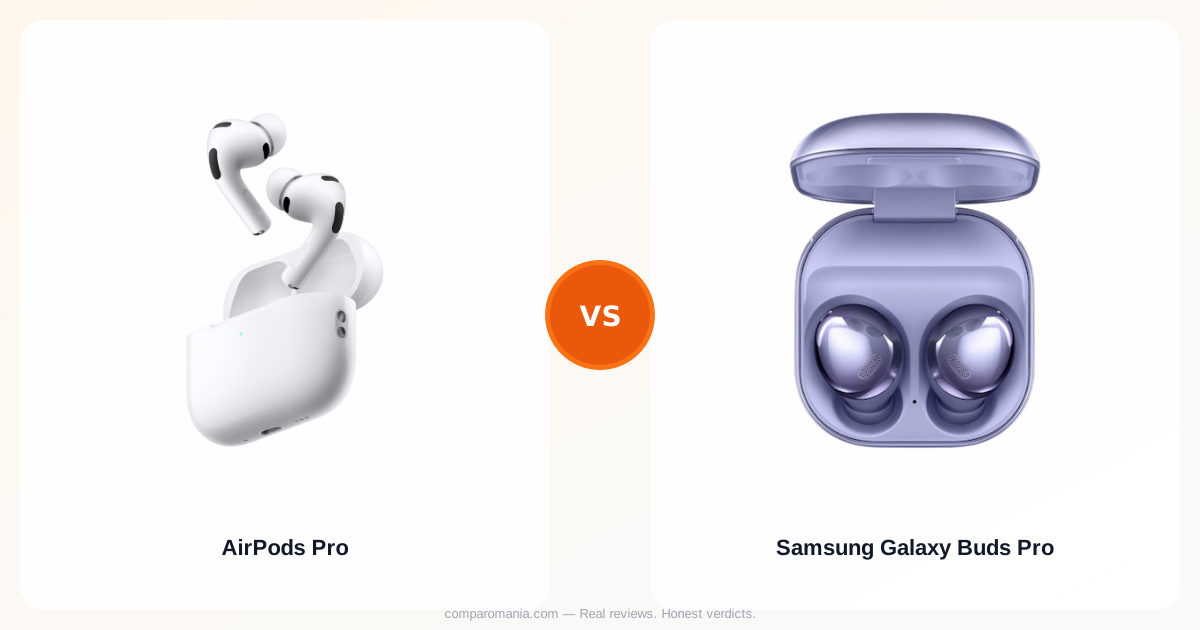
You've already made the phone decision. Now you're trying to figure out whether the earbuds that came bundled in every ad for the past two years are actually worth it, or whether the other brand's version is better for the $50 price difference. The specs read almost identically. Both promise ANC, spatial audio, call quality, water resistance. So which one do you actually buy?
This comparison covers the AirPods Pro 2nd generation and the Samsung Galaxy Buds 2 Pro, two earbuds that launched within weeks of each other in late 2022 and spent the next three years as the benchmark pair in their respective ecosystems. Both have since been superseded by newer flagships, which is exactly why they're worth comparing now: you can get either one at a fraction of the original ask.
What you're actually paying in 2026
The AirPods Pro 2 (USB-C variant) launched at $249. Refurbished units now sit around $139.99, and that's a verified retail figure, not a grey-market guess. Apple officially discontinued the 2nd generation in September 2025 when the AirPods Pro 3 took over at $249.
The Galaxy Buds 2 Pro launched at $229. Current pricing on Amazon sits around $179.49, and you can find certified refurbished units cheaper. Samsung discontinued the Buds 2 Pro in July 2024, so supply is thinning, but it hasn't yet vanished from mainstream retailers.
At their current street prices, the AirPods Pro 2 refurbished ($139.99) is noticeably cheaper than a new Buds 2 Pro ($179.49). Whether that gap matters depends on what you lose in the transaction, and refurbished AirPods from Apple's own certified programme carry the same one-year warranty as new.
The ANC gap is real, not marketing
Testing confirms both earbuds do a good job blocking noise, but the AirPods have a slight edge, the Galaxy Buds 2 Pro's ANC struggles with low-frequency noise below 100Hz and mid-range noise around 500Hz. That matters on a subway or a plane, where engine drone sits right in the 60–120Hz band.
Apple's H2 chip delivers improved ANC and battery life, while the case's U1 chip adds precision location via Find My. The Galaxy Buds 2 Pro runs on Bluetooth 5.3 with Samsung's SSC codec for high-res audio, a genuine advantage, but only if you're on a Samsung Galaxy phone that supports it.
Samsung introduced 24-bit HiFi sound and stronger ANC with the Buds 2 Pro, and audiophiles on the Samsung side do genuinely notice the difference in music detail. But in actual commuting or office conditions, the AirPods' low-frequency cancellation is more useful than an extra 2 bits of depth on a Spotify stream.
Battery: the number they advertise isn't the number you get
This is the one the marketing materials bury.
The Galaxy Buds 2 Pro is rated 5 hours with ANC on, and 18 hours total with the charging case. Apple tests the AirPods Pro 2 with ANC enabled at 50% volume, and rates them at up to 5.5 hours per charge with Spatial Audio on. On paper, nearly identical. In practice, something else is happening.
The shorter battery life of the Samsung earbuds means more frequent charge cycles, which shortens the life expectancy of the product. That compounds over 18 months. Aggregated owner reports flag that AirPods Pro 2 battery drops to around 4.5 hours after 18 months of daily use, and that's for a product with stronger initial ratings. The Samsung degrades on a steeper curve from a lower starting point.
Neither manufacturer makes battery replacement easy or cheap, which brings us to the cost most buyers don't calculate until it's already a problem.
The cost nobody is tracking until month 20
Here's what doesn't appear in any spec comparison: battery degradation in both products is non-linear, and neither Apple nor Samsung sells a consumer-grade battery replacement service. You can send them in, but you're typically looking at a replacement unit at near-retail pricing once the warranty lapses.
The Buds 2 Pro ships with a one-year warranty in the US. Samsung hadn't meaningfully addressed low battery life or mic quality from the original Buds Pro to the Buds 2 Pro. That's not a knock on the product, it's a signal that Samsung treats 5-hour ANC runtime as acceptable across generations, so don't expect the degradation problem to fix itself via firmware.
For AirPods, Apple's battery service is $49 per earbud out of warranty. Samsung's is comparable. At $139 for refurbished AirPods Pro 2, one battery service wipes out most of your savings over a new pair, which is a quiet argument for buying new if you plan to keep them for three years.
Both brands have the same structural problem here. The earbuds are sealed, the batteries are small, and neither company wants you thinking about this at the point of purchase.
Fit, build, and the question of comfort after an hour
Samsung reduced the size of the Buds 2 Pro by 15% compared to the Galaxy Buds Pro, and long-term owners report that the fit is comfortable enough that some forget the buds are still in their ears after extended use. That's a meaningful quality-of-life claim, and the user reports that back it up are consistent.
The AirPods Pro 2 uses the same basic stem-and-tip design as the first generation, with silicone ear tips in four sizes. Owners consistently praise the fit, "seamless switching" and comfort appear in positive reviews across 90,000+ verified listings. The stem design divides people who've never worn AirPods, but converts nearly everyone who spends a day with them.
The Galaxy Buds 2 Pro carries an IPX7 water resistance rating, which means it survives immersion up to one metre for 30 minutes. The AirPods Pro 2 is rated IPX4, splash and sweat resistant, not submersible. For gym use, IPX4 is fine. For anyone who runs outdoors in heavy rain or routinely forgets to take them out before jumping in a pool, IPX7 is the better spec.
The Buds 2 Pro's matte coating has a more premium feel in hand. AirPods' gloss case scratches faster. Neither falls apart, but Samsung has a small edge on materials.
Ecosystem: this is where the choice actually gets made
AirPods and Galaxy Buds are both tightly woven into their respective Apple and Samsung ecosystems. The honest version of this is: if you have an iPhone, buy the AirPods. If you have a Samsung Galaxy phone, buy the Buds 2 Pro. The feature gap in both directions is large enough to make the "wrong" choice feel half-baked.
Galaxy Buds 2 Pro work on iPhone via standard Bluetooth pairing, but you lose automatic device switching, and all Samsung-specific customisation requires the Galaxy Wearable app, which needs an Android device. All Samsung Galaxy Buds work with iPhone via Bluetooth, but advanced features like automatic device switching, Bixby integration, and Galaxy Wearable app settings require a Samsung device.
Going the other way, AirPods Pro 2 on Android gives you audio and calls. You lose Adaptive Audio, Personalized Spatial Audio, automatic device switching, and Find My precision finding the moment you pair to a non-Apple device. Basic controls still work, but you've paid for a $249 product and unlocked maybe 60% of it.
If you own a Galaxy smartphone, the Buds 2 Pro are a straightforward recommendation. If you own an iPhone, same logic applies in reverse, the AirPods Pro 2 isn't just the better choice, it's functionally a different product on Apple hardware than on anything else.
Call quality and real-world mic performance
Samsung's HD Voice technology is designed to separate your voice from surrounding noise, and in quiet-to-moderate environments it works well. Voice Detection drops the volume to 15% when it hears you speaking, so you can converse without removing the buds.
Samsung hadn't changed much on mic quality from the original Buds Pro to the Buds 2 Pro, which is the more honest summary. Reviewers who praised the hardware audio performance noted the mic as a persistent weak point in noisy environments.
AirPods Pro 2 owners consistently flag the stem controls as a positive, the ability to adjust volume without reaching for a phone is a small thing that becomes a daily-use quality of life feature. On calls, the AirPods' beamforming mics perform better in wind and street noise, which is where call quality actually gets tested.