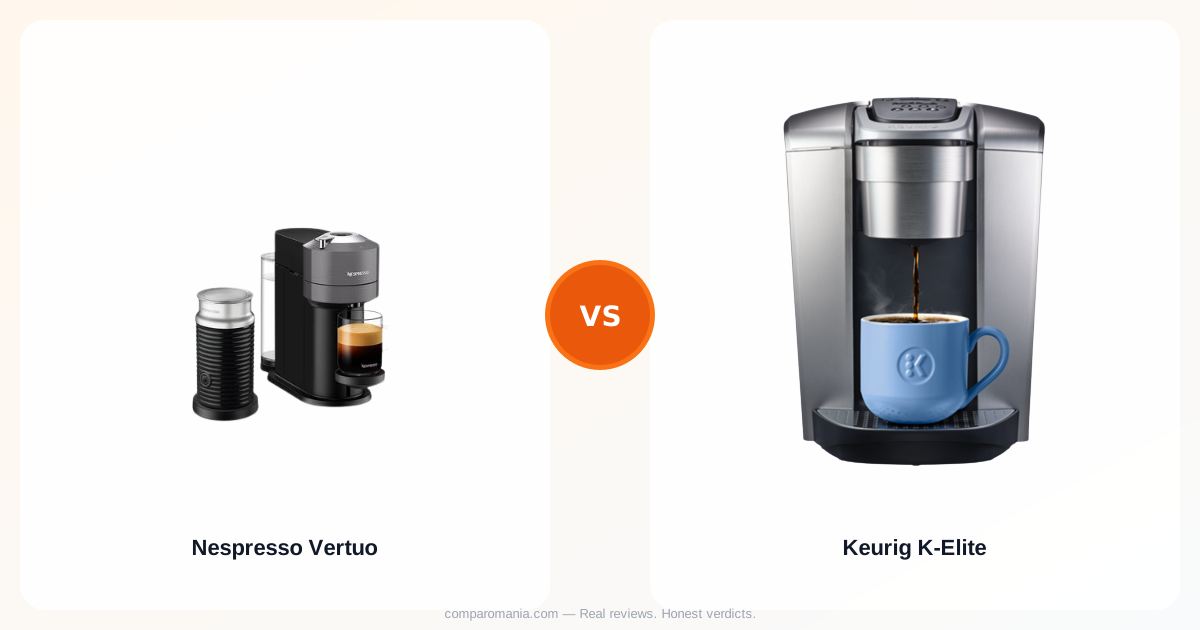
You've already made one decision: you're not buying a drip machine. Now you're stuck between two pod brewers sitting at almost identical prices, wondering what the $10 difference actually buys you. It's a fair question. The answer isn't about the machines. It's about what kind of coffee drinker you are, and what that costs over the next two years.
What you're actually paying at the register
The Nespresso Vertuo Plus carries an MSRP of $169–$179.99. The Nespresso Vertuo Plus comes in at $179.99, which starts far higher than most Keurig options. The Keurig K-Elite sits at $169.99 MSRP, but it regularly comes in under $150 due to frequent discounts, even if the MSRP sits at $169.99. In practice you can often catch it around $127–$130 during sales. The Vertuo Plus also goes on sale, sometimes to $85–$118, but those windows are narrower and less predictable.
On paper: nearly identical. In the cart on any given Tuesday: the K-Elite is probably $20–$40 cheaper. Neither machine is expensive by espresso standards, which makes the pod math, explained below, the number that actually matters.
The cup in your hand every morning
This is where the two machines stop being comparable and start being different products entirely. Nespresso's brewing system uses 19 bars of pressure and precise temperature control, and the Vertuo line goes further with Centrifusion technology that spins the pod at up to 7,000 RPM, creating its signature crema and rich coffee profile. The K-Elite uses a simpler drip-style approach. Keurig functions more like a traditional drip coffee maker, and even its newer models with MultiStream technology don't match Nespresso's pressure-based extraction system.
In real-world terms: the Vertuo produces a dense, crema-topped cup that reviewers and testers consistently put above anything the K-Elite achieves. Professional reviewers from Corner Coffee Store, Reviewed/USA Today, The Spruce Eats, and others consistently rate Nespresso's coffee quality higher than Keurig's. That said, the K-Elite made some of the strongest coffee of any Keurig tested, with adjustable water temperature and five cup sizes from 4 to 12 ounces, plus a strong brew and iced coffee mode.
So the K-Elite is a good brewer. It's not in the same category as the Vertuo when it comes to cup quality. If you drink drip-style coffee and want quantity and flexibility, the K-Elite holds its own. If you want crema, you need the Vertuo.
The number nobody calculates before buying
Here's the cost that accumulates quietly until it's suddenly significant. The machine price is a one-time spend. The pods are forever.
Keurig K-Cup pods average $0.35 to $0.65 per serving. Nespresso VertuoLine pods now cost $0.90 to $1.35 per serving. Some premium Vertuo capsules push to $1.50. Over a year at daily use, the difference between a basic Keurig setup and a mid-tier Nespresso system totals nearly $160–$162 more for Nespresso. Over two years, that's $320+, which is almost double the machine cost.
The Keurig side has another advantage here that's easy to underestimate. Keurig demolishes Nespresso in sheer pod variety, over 400 different K-Cup options exist from 60-plus brands, available at any grocery store, gas station, or office supply store, including Dunkin', Starbucks, Green Mountain, Caribou, and non-coffee options. Vertuo pods, by contrast, come only from Nespresso and recently Starbucks, with no meaningful third-party options.
The reusable filter question matters here too. The K-Elite can brew ground coffee using the Universal My K-Cup Reusable Coffee Filter, sold separately. The Vertuo cannot use reusable pods, the barcode-reading Centrifusion system requires official capsules. Once you buy into Vertuo, you are committed to Nespresso's pricing for life.
Design and build: the machine you look at every day
The Vertuo Plus is slim, modern, and genuinely well-built. The machine doesn't take up too much counter space, with a 40-ounce water tank that's adjustable to best fit your space. The motorised head opens and ejects used capsules automatically. It looks like it belongs in a 2020s kitchen.
The K-Elite is a different story. Reviewers have called out its clunky design, with one noting it looks like something you'd see in a 1990s office kitchen. The brushed-metal finish helps, but the body is large and the overall silhouette is dated. What it does have is a genuinely large reservoir. The K-Elite's 75-ounce removable water reservoir lets you brew roughly eight cups between refills, alongside programmable features like auto-on and temperature control. For households running multiple cups a morning, refilling every two days instead of daily is a real convenience.
Long-term durability is harder to call cleanly. Nespresso machines often last five to seven years with proper care, while Keurig machines typically last two to three years, though some users report shorter lifespans. Nespresso also backs the Vertuo with a two-year warranty; Keurig machines come with a one-year warranty. Whether the K-Elite's actual build quality matches the Nespresso at the three-year mark is genuinely unclear, user reports vary enough that no honest answer fits everyone.
Features and daily usability
The K-Elite wins on configurable options. You can change the water temperature, select a high altitude setting, choose from five cup sizes, and use both strong brew and iced coffee modes. There's also a hot water on demand option, useful for tea or Americanos. The machine shuts off two hours after its last brew automatically.
The Vertuo's interface is intentionally simpler. One button, one lever. Both Vertuo machines spin the pod at up to 7,000 RPM to extract coffee through barcoded centrifugal force, meaning brew quality is largely determined by the pod, not the machine. You're not adjusting anything, Nespresso has pre-set everything to the pod's barcode. That's a feature if you want consistency. It's a limitation if you want control.
One tester used her K-Elite at least five times per week for six months and found that with regular cleaning it still performs like new. Nespresso includes a descaling reminder and automated cleaning cycle on the Vertuo, which is a small but real advantage for owners who won't think about maintenance until something goes wrong.
Ecosystem lock-in: the choice you make once
This is the structural reality both brands gloss over in their marketing. The choice between Nespresso and Keurig isn't just machine versus machine, it's an espresso-format ecosystem versus a drip-format ecosystem, and once you choose, you're locked into the pod selection that ecosystem offers. That's not a small decision.
Keurig's ecosystem is open in a way Nespresso's simply isn't. Keurig runs on one format: plastic-bodied K-Cup pods with a foil top, and virtually every major North American coffee brand sells K-Cups, plus a broad catalogue of tea, hot chocolate, and other options. You can walk into any supermarket in the US, Canada, the UK, or Australia and find K-Cups.
Vertuo pods are harder to source outside major cities and online ordering. If your local supermarket doesn't stock them, you're ordering from Nespresso directly, and waiting. For travellers or anyone living outside a major metropolitan area, that friction is real.
Long-term ownership: what two years actually costs
Two-year total cost of ownership, assuming one cup per day:
That's a gap of $300–$500 over two years on identical daily usage. The Vertuo produces a better cup. Whether that cup is worth $300–$500 more is a genuine personal question, not a rhetorical one. But most buyers making this decision haven't run the number, and the number is large enough to change the answer.
Nespresso offers a two-year warranty while Keurig only offers a one-year guarantee, which partially offsets replacement risk for the Vertuo. Still, if you're cost-sensitive, the K-Elite's total cost profile is significantly more manageable.